Math Skills Every Student Should Have Before Graduating High School
I’ll be the first to admit that math was never my strong suit. Not gonna lie, I may have had a little extra help passing college algebra. I had hoped my kids would escape the “poor math gene,” but both of my girls found math just as tough as I did. More than once I heard, “When will I ever use this?” And honestly, I couldn’t blame them for asking.
I know I am not alone, every teen has asked it at least once. The honest answer is that strong everyday math skills show up everywhere. From planning a budget to doubling a recipe to figuring out travel costs, numbers are part of real life. Below is a practical checklist of the math skills for high school that your student should be comfortable using by graduation, along with simple ways to practice each skill at home.
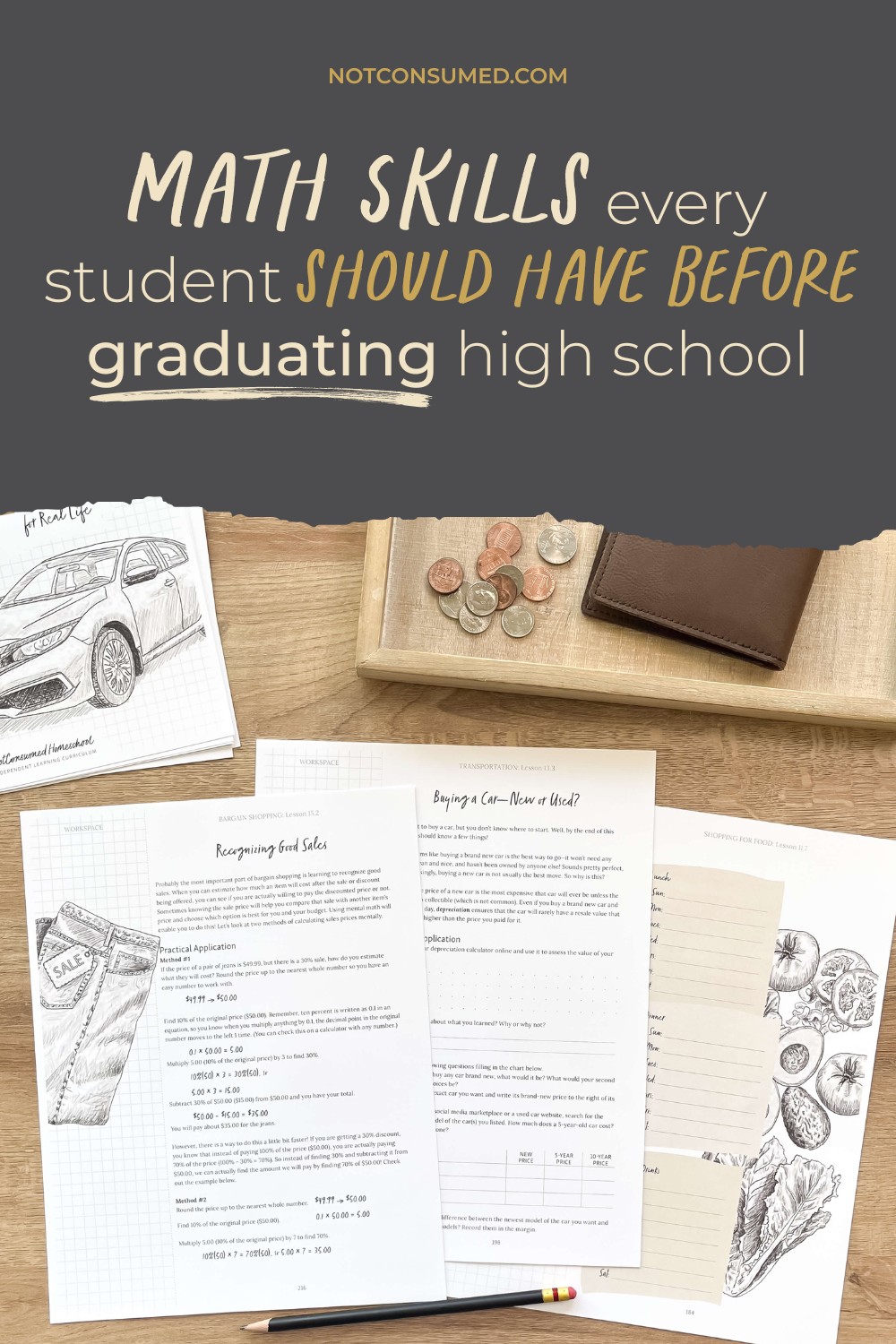
Table of Contents
Everyday Math Your Teen Will Actually Use
It starts with the basics. Before your teen can tackle bigger responsibilities, they need a firm handle on simple math and how it applies outside of worksheets. These skills are the building blocks that make daily problem-solving possible.
And sometimes, practice looks like real life. My kids have learned fractions by cutting pizza into uneven slices, percentages by figuring out sale prices at their favorite store, and multiplication by deciding just how many cookies we’d end up with if we doubled the recipe.
- Add, subtract, multiply, and divide: These power basics drive nearly every real-life calculation. Practice by tracking weekly spending, splitting a restaurant bill, or timing chores.
- Fractions, percentages, and ratios: Life is full of halves, quarters, and parts of a whole. Show how a 25 percent discount changes a price, what a 3 to 2 recipe ratio looks like, or how a 70 to 30 savings split builds a bank account.
- Graphs and charts: Reading and creating simple visuals builds understanding and communication. Have your teen chart monthly income and expenses, hours worked, or miles driven.
- Model real-life math: Turn situations into solvable problems. Example: If the backyard is 60 feet by 35 feet, how many linear feet of fencing are needed? What is the total cost at the current price per foot?
Money Skills Every Graduate Should Have
Money management may be the single most practical application of math after graduation. From paying bills to saving for the future, math gives your teen the tools to handle money with confidence instead of fear.
That’s one of the reasons I love Consumer Math. Long before I ever joined the team here, we used this curriculum at home. It gave my middle child a chance to apply math in ways that actually mattered to her. When she wanted to save for a car, Consumer Math helped her map out exactly how much she needed to save, what choices she had to make, and how long it would take to reach her goal. Suddenly, math wasn’t just numbers on a page; it was a tool for making her dreams possible.
- Set and manage goals: Teach your student to define a goal, choose a timeline, and break it into steps. Saving for a used car like my daughter did, planning a mission trip, or paying a sports fee are great places to start.
- Inverse operations for quick discounts: Instead of finding 20 percent and then subtracting it, multiply the price by 0.80 to get the final cost in one step.
- Interest and debt: Understand how interest grows a balance over time and how minimum payments affect payoff. Read a statement together and calculate the true cost of borrowing.
- Interest and savings: Compare simple and compound interests. Use a small savings goal with a realistic rate so teens can see growth over months, not just years.
- Budgeting: Create a spending plan that balances income and expenses. Include giving, savings, fixed bills, and a small category for surprises.
- Estimation: Make quick mental estimates to check whether a purchase or project fits the plan. Round numbers to keep it fast and accurate enough.
- Choosing a home and car: Discuss needs versus wants, gas mileage, insurance, maintenance, location, and total cost of ownership. Compare a used option with no payment to a newer option with a payment and warranty.
Math Skills In The Kitchen
The kitchen is one of the easiest classrooms for everyday math. Recipes, conversions, and cooking times all reinforce critical skills in a way that teens can see, taste, and enjoy.
- Fractions in action: What happens when the recipe calls for one cup and the only measuring cup is one-quarter? Your teen should be able to combine fractional units to make it work.
- Volume and weight: Measure liquids and weigh ingredients for consistent results. Show why flour by weight is more reliable than a packed cup.
- Unit conversion: Move between teaspoons and tablespoons, cups and quarts, and metric and imperial units.
- Time and temperature: Adjust bake time when changing pan sizes or oven temperature. Learn why a smaller portion cooks faster.
- Scaling recipes: Halve a recipe for two people or multiply it for a crowd. Adjust spices and cooking vessels accordingly.
- Portions and serving cost: Calculate the cost per serving and compare homemade to store-bought options.
- Cooking ratios: Teach simple anchors like one part rice to two parts water or one part oil to three parts vinegar.
Math For Health And Wellness
Health decisions often rely on numbers. Whether it is comparing nutrition labels, tracking exercise, or understanding medical care, math helps teens make wise choices that affect their well-being.
I remember teaching my son how to check his own pulse after running around outside. He thought it was hilarious to count “heartbeats per minute” with a stopwatch, but before long, he could tell when his body was working hard and when it was recovering. Even little lessons like that give kids lifelong skills.
- Nutrition and meal planning: Read labels, compare serving sizes, and total daily nutrients within a budget.
- Portion sizes: Measure what a real serving looks like and convert that to calories and macros if needed.
- Comparing medical costs: Call for cash prices, compare urgent care to primary care, and read plan documents. Practice finding the least expensive appropriate option.
- Monitoring vital signs: Count pulse and respirations, read a thermometer, and understand blood pressure numbers.
- Medical dosing: Calculate a safe dose based on weight and schedule doses by time. Always follow labels and provider directions.
Math For Taking Care Of Your Home
Owning or renting a home comes with constant projects. Knowing how to measure, calculate, and estimate ensures that your student can plan and complete tasks without waste or overspending.
My daughter needed to figure out how many gallons of paint it would take to redo her bedroom. This meant she had to figure out her room measurements, calculate the area, figure out coverage per gallon, and even compare prices at different stores. By the end, she had learned a valuable lesson that she will take with her into her first apartment.
- Perimeter: Find linear measurements for fencing, baseboards, or trim.
- Area: Calculate square footage for flooring, paint, mulch, or seed.
- Volume: Determine cubic yards of soil for raised beds or water volume for pool chemicals.
- Estimating project costs: Combine measurements, unit prices, taxes, fees, and a sensible buffer for waste or overage.
Smart Shopping Math
Every shopping trip is a math lesson in disguise. Teens who understand how to compare costs, track sales, and budget their cart will save themselves frustration and money for years to come.
In our house, one of the most common arguments was which brand was the “better deal.” My kids learned quickly that you often pay for the name on the box. And that sometimes isn’t worth the extra price per ounce.
- Unit pricing: Compare cost per ounce or per sheet to find the real deal
- Sale percentages: Calculate final prices with stacked discounts and rewards.
- Price tracking: Use a simple spreadsheet to record unit prices so you can spot true sales.
- Cost per use: Divide the price by expected uses. A durable item that lasts eight years may cost less per use than a cheap item that fails in two.
- Budgeting the cart: Track the total as you shop and adjust in real time to stay within limits.
Travel Math That Reduces Stress
Travel planning becomes smoother when you factor in the numbers ahead of time. From mileage to money, teens who practice these skills will be able to plan wisely and adjust on the go.
When we travel for vacation or a road trip, I have my kids help figure out how much gas money we need. Tracking miles, calculating cost per gallon, and even adding in the cost of tolls are all valuable lessons that they can learn now, before they ever launch into adulthood.
- Time zones: Plan arrivals, departures, and calls with time differences in mind.
- Currency conversion: Identify local currency and current conversion rates. Compare exchange options and fees.
- Cost comparison: Weigh a hotel with breakfast against a rental with a kitchen. Add parking, resort fees, and cleaning fees to make a fair comparison.
- Tips: Calculate fair gratuities for meals and services quickly and confidently.
- Mileage and fuel: Estimate total miles, miles per gallon, and current fuel cost to budget the trip.
- Total trip cost: Add transportation, lodging, food, activities, and souvenirs to build a realistic plan that matches the budget.

Turn These Skills Into A Credit Worth Having
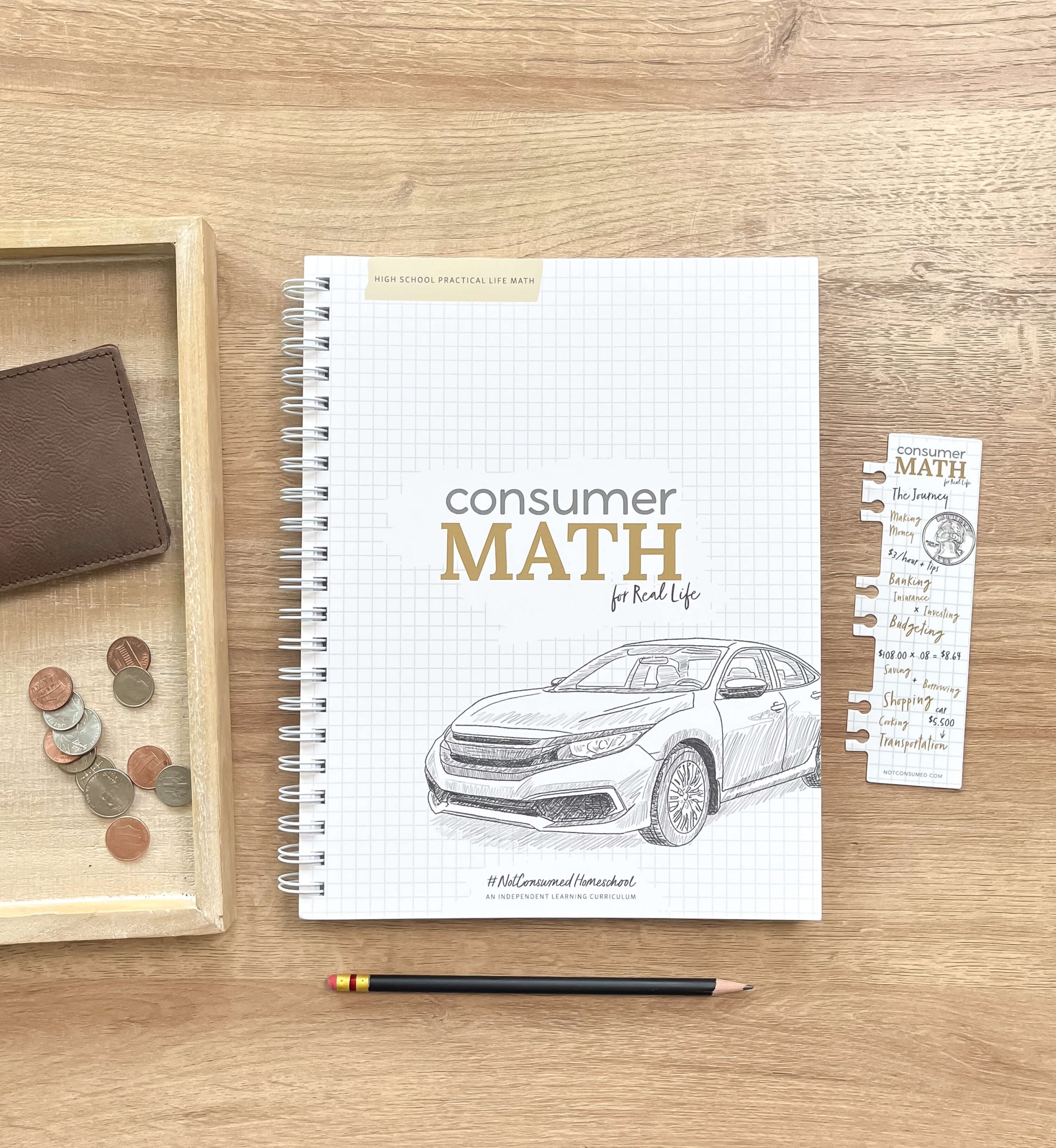
If your student is not headed for a STEM path, you may be wondering what counts as meaningful high school math. Consumer Math for Real Life turns many of the skills above into a full and purposeful math credit in 11th or 12th grade. It is project-based rather than worksheet-heavy, which means your teen learns by doing.
Inside you will find:
- Sixteen real-life units that cover saving, investing, income, taxes, benefits, the real cost of living, and more
- Twenty-two projects that include building a working budget, writing a simple business plan, comparing housing choices, calculating flooring for a room, and planning a trip with a true cost breakdown
- Clear instruction in critical thinking so students can choose wisely in new situations
- Guidance that is grounded in the truth of God’s Word, helping teens connect wise decisions to biblical wisdom
This course is designed to fulfill a full math credit for high school, and it is most effective when students are close to launching, since the decisions feel real. As always, check your state or local requirements to confirm how credits are recorded for your homeschool..
You can preview Consumer Math for Real Life here and see how the projects align with the skills in this post. When your teen finishes, they will understand the math they will actually use, and they will be ready to handle life with confidence.

Quick Graduation-Ready Checklist
It can feel overwhelming to keep track of all the math your teen should know before graduation. That’s why it helps to have a simple list. Use this checklist as a quick reference to spot any gaps, celebrate what your student already knows, and make a plan for the skills they still need to practice.
- Can calculate with whole numbers, fractions, percentages, and ratios
- Reads and creates simple charts to communicate information
- Chooses efficient methods to solve real-life problems
- Builds and maintains a monthly budget and savings plan
- Understands interest on debt and interest on savings
- Converts units in the kitchen and scales recipes
- Measures perimeter, area, and volume for home projects
- Compares unit prices, discounts, and cost per use
- Plans trips with time zones, currency, mileage, and total cost in mind
Keep It Practical
Pick one skill and put it to work this week. Let your teen run part of the grocery trip, plan a simple meal, price a small home project, or map the next family day trip with a budget. Real choices create real learning.
Looking back, I wish I had learned these things in high school myself. Understanding how to budget, how taxes work, or even how to plan a healthy meal would have saved me a lot of stress in my early adult years. That’s why I’m so thankful my kids have the chance to practice these skills through Consumer Math for Real Life. It’s the kind of math they’ll use long after the last textbook is closed.

Through practical tools & Bible-based resources, Kim Sorgius is dedicated to helping your family GROW in faith so you can be Not Consumed by life’s struggles. Author of popular kid’s devotional Bible studies and practical homeschooling tools, Kim has a master’s degree in education and curriculum design coupled with over 2 decades of experience working with kids and teens. Above all, her most treasured job is mother and homeschool teacher of four amazing kiddos.