
5 Reasons to Study Missionaries With Your Kids
As parents, we spend a lot of time thinking about what will shape our kids’ faith. We plan, research, and choose resources carefully. And yet, sometimes the things that shape our kids’ faith most deeply don’t come from what we planned at all.
That’s exactly what happened in our home.
We opened one book, just one, and suddenly my kids were seeing courage, obedience, and trust in God in an entirely new way. It changed how they prayed. It changed how they handled hard things. And it changed how they saw the world.
What was the book? Well, let me take you back a little bit …
I was at a homeschool convention and noticed a long line wrapped around a book booth. I don’t know about you, but for me, when I see a crowd, I assume something worthwhile is happening. I squeezed in and grabbed a book from the biggest stack on the table.
It was a biography of Hudson Taylor.
I’ll be honest, I didn’t know who he was. The book went on our shelf and sat there for months. I kept thinking we should read it, but I was convinced it would be boring.
One evening, we finally opened it together. We read for over an hour straight! We moved from chapter to chapter without stopping, and when I finally said we had to stop, my kids were disappointed. That was not what I expected at all. It was supposed to be a boring book!
That one book led to many more, and it completely changed how our family sees the world. Studying missionaries has been one of the most meaningful things we’ve done as a family. Not because it was flashy or complicated, but because it quietly did its work over time.
Here are five reasons I believe studying missionaries deserves a place in your homeschool day.
1. Missionaries Give Kids Real-Life Examples of Faith
I don’t want my kids idolizing people. But I do want them to see what trusting God looks like when it actually costs something. At home, we model faith within the limits of our own lives. Missionary biographies let kids see believers trusting God in situations most of us will never face. They read about Hudson Taylor trusting God for provision while serving in China without ever asking for donations. They hear how Corrie ten Boom chose forgiveness instead of bitterness after surviving a concentration camp.
These were not perfect people. They were ordinary believers facing fear, loss, and uncertainty, and choosing obedience anyway. The beautiful thing here is that our kids get to learn these lessons without having to experience the same danger or trauma themselves.
2. Missionary Stories Make History Come Alive
Missionary stories have a way of making history feel real. Instead of memorizing dates or reading dry summaries, kids step into a time period through the lens of someone’s life.
When you read about George Müller, you’re learning about Victorian England while watching radical faith lived out through orphan care. Learning about Gladys Aylward places kids in wartime China, watching courage and perseverance unfold under pressure. Exploring the life of Elisabeth Elliot opens the door to tribal cultures in the Amazon and the cost of obedience when outcomes are unclear.
Kids absorb geography, world cultures, historical events, and church history almost without realizing it. They are too engaged in the story to notice they are learning. These biographies span different countries and generations, giving kids a global view of how God has worked throughout history. It’s way more engaging than any history textbook could ever be, helping kids make connections that stick.
3. Missionary Stories Put Everyday Problems Into Perspective
Missionary stories bring perspective, not in a guilt-driven way, but in a grounding one. Before we started reading these stories, it was easy to let small frustrations feel enormous. Then we read about Amy Carmichael rescuing children from temple slavery in India. We heard about David Livingstone walking thousands of miles through disease-filled jungles to reach people who had never heard the gospel.
Your definition of “hard” begins to shift when you read these stories. Instead, you grow in gratitude and compassion. Kids start to see that the world is much bigger than their immediate circumstances. That perspective quietly builds courage. When they face their own challenges, they’ve already seen what real perseverance looks like.
4. Missionary Stories Are Genuinely Captivating
I was convinced these books would be boring. Boy, I was completely wrong. They are full of adventure, risk, and impossible situations.
Whether your family is learning about William Carey translating Scripture while facing persecution, hearing about Nate Saint flying planes into remote jungle regions, or reading about Mary Slessor stepping into tribal conflict and stopping wars through courage and persistence, your kids’ eyes are opened to a world they will likely never experience.
These stories read like adventure novels, except they’re true. Even kids who struggle to sit still will ask for one more chapter. And parents usually find themselves just as invested. There’s something about hearing how these ordinary people did extraordinary things for God that just draws you in and won’t let go.
5. Missionary Stories Inspire Practical, Everyday Faith
Missionary stories don’t just inform kids, they inspire real, everyday faith. They show that God uses ordinary people. Not superheroes and not people who had everything figured out. He uses people who are simply willing.
After reading these stories, prayer becomes more natural. Kids start praying bigger prayers because they’ve seen what God can do. They notice needs around them and ask how they can help.
These stories teach kids that following Jesus isn’t just about being good. It’s about being willing to be used by God wherever He calls them. Maybe that’s across the ocean, or maybe it’s across the street. Either way, through these stories, they’re learning that their lives can make an eternal difference.
How to Start Studying Missionaries as a Family
So, how do you actually start doing this with your family? The simplest place to begin is by picking up a missionary biography and reading it aloud together. That alone can be so powerful. But many parents eventually realize they want consistency without having to plan everything themselves.
That’s why we created To Every Nation and Send the Light.
These are family flipbooks designed to be used together around the table during morning homeschool time or as part of your morning basket. They are simple read-alouds that take about 10 to 15 minutes a day, with no prep required.
To Every Nation covers ten foundational missionaries, including the apostle Paul, George Müller, William Carey, Hudson Taylor, and Mary Slessor. Send the Light continues the journey with ten more. Kids will read about David Livingstone, Amy Carmichael, and Gladys Aylward, along with Jonathan and Rosalind Goforth. You can use them in any order, or do one followed by the other for a full year of missionary study!
Each missionary is studied over the course of ten days. On the tenth day, there’s a Family Mission Challenge that helps you apply what you’ve learned by serving together in your local community.
There are also age-appropriate activity books and journals that go along with the readings:
- Younger kids work through coloring pages, stickers, and hands-on activities that help them visualize and interact with each missionary’s story.
- Older kids use journals with writing prompts, Scripture copywork, games, and reflection activities that really deepen their understanding.
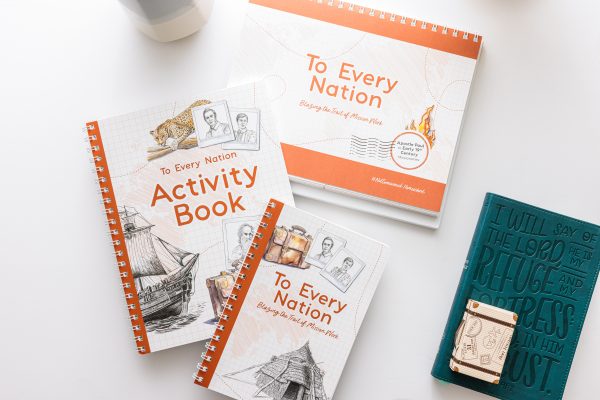
Everyone learns the same content in a way that fits their age. These studies naturally integrate history, geography, Bible study, and character development through real missionary stories. The goal is not to add more to your plate, but to make family discipleship simpler.
You don’t need prior missions knowledge, and you don’t have to juggle multiple resources. Simply open the flipbook, read together, and let the materials do the rest.
Studying missionary biographies has shaped our family in quiet but lasting ways. It has given my kids strong examples of faith, helped them understand history, grown their compassion, and shown them what obedience looks like in real life.
If you’ve been looking for a meaningful way to build faith in your homeschool, studying missionaries is one I firmly believe is worth making space for.

Through practical tools & Bible-based resources, Kim Sorgius is dedicated to helping your family GROW in faith so you can be Not Consumed by life’s struggles. Author of popular kid’s devotional Bible studies and practical homeschooling tools, Kim has a master’s degree in education and curriculum design coupled with over 2 decades of experience working with kids and teens. Above all, her most treasured job is mother and homeschool teacher of four amazing kiddos.