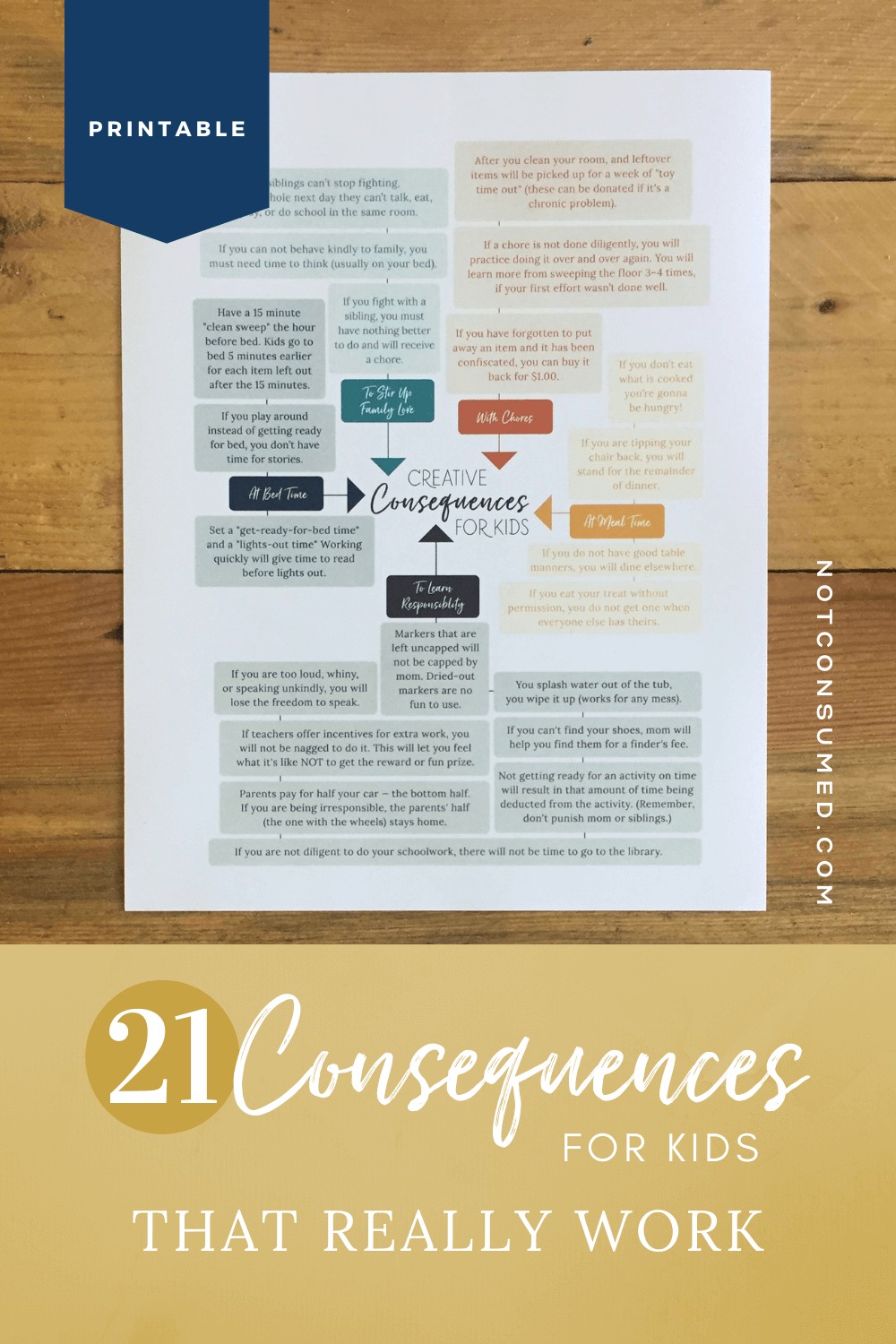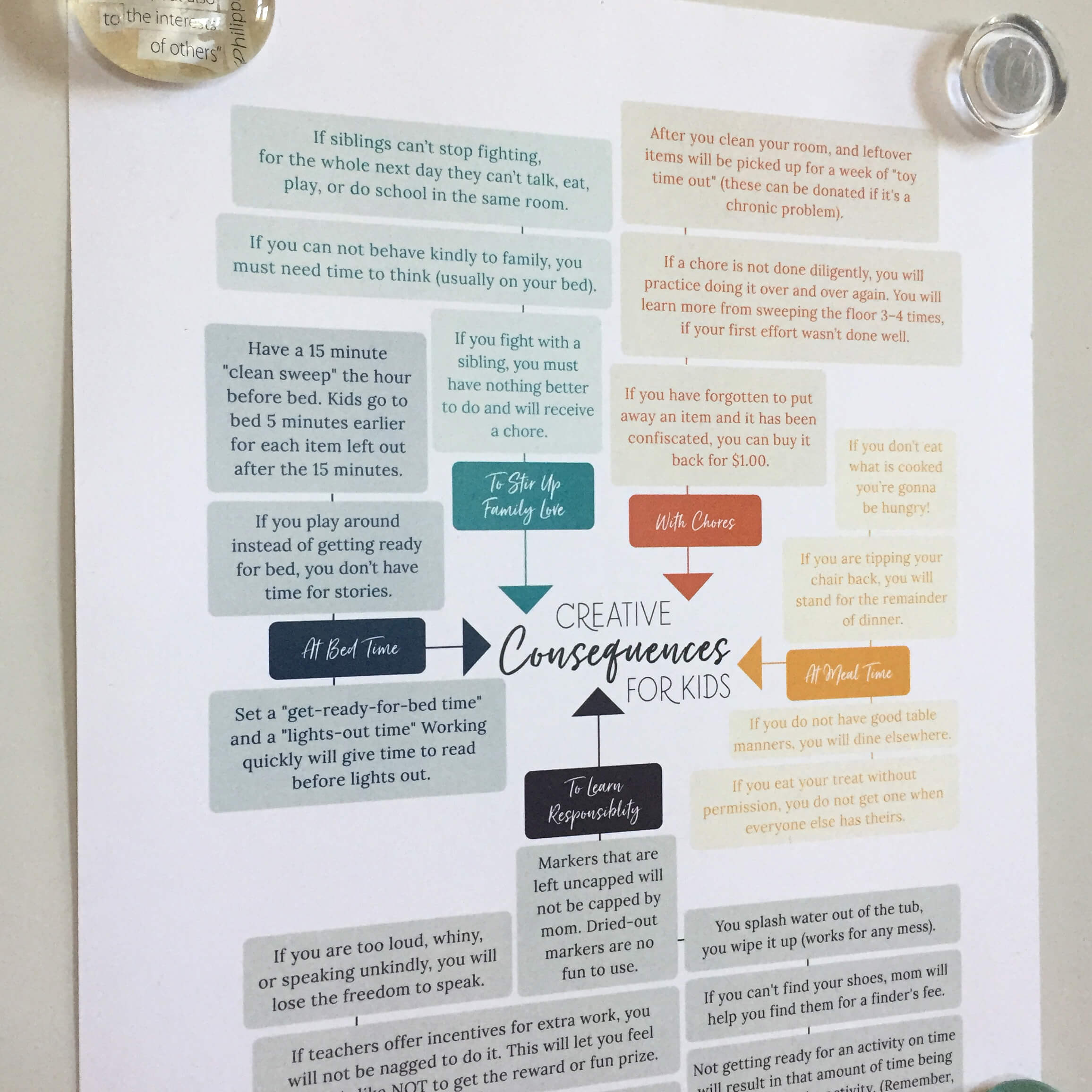
creative consequences for kids


Teach Your Child to Read Online

After 8 years of parenting and reading more books than I can count, I feel confident in only one thing. This parenting thing is HARD, ya’ll. There isn’t a one-size-fits-all answer for our parenting questions. I really thought that there was.

Follow a formula and your kid will do “this.”

If you, put them on a schedule…they will sleep through the night at 3 months.

If you are consistent in your training…they will obey the first time you ask.

If you conduct a potty boot camp…they will potty train in less than 3 days.

I have come to realize just how laughable this really is. There is absolutely nothing wrong with any of the above ideas. In fact, most of them have worked for me at least with some of my kids, some of the time. The trouble lies in our demanding that they work in all situations. And if we do that, we are ignoring the fact that children are humans. Natural born, flesh filled, sinners (Romans 6:23). Even the best of us are prone to give in to momentary pleasures, throwing caution to the wind.

Besides that, there is also the fact that children are different. Between my four children and the numerous other children that I have taught, I have seem everything from perfectionist to uninterested, compliant to defiant, thoughtful to manipulative, and calm to active. The list goes on and on and I seriously doubt that I have seen it all.

Bearing all of this in mind, there are two loose parenting principles that I have adopted as a regular practice. Most of the time, they seem to work.

Rules are simple.

Rules should be few and simple. They can’t be too difficult to remember or to vague that they include loop holes. For a long time, my rule was simply LOVE. Quite some time ago, my friend Lara introduced me to her version of this concept…Love up and Love out. I’ve used that saying ever since. After all, love covers a multitude of sins. No really, this rule covers pretty much every offense in my home.

I might ask: How are you showing love in this situation? Is there something that you could do to be more loving? When you didn’t pick up that shoe in the stairs, do you think you showed love and concern for the well being of your family who might trip over it?

When rules are simple, consequences are natural or logical.

As much as possible, I avoid terms like “time-out” and “restriction.” For the most part, I have found that a blanket consequence is ineffective in molding hearts and changing behavior. This is where consequences come in.

A natural consequence will be adminsted without mom’s help. For example, a child runs on the sidewalk, trips and skins his knee. A logical consequence is closely related to the offense and is aimed at teaching responsibility for your actions. Whenever possible, I include scripture. (guess we will have to do a post on that later)

A few of the ideas that I have used…

If you can’t find your shoes, mom will help you find them, but there will be a finder’s fee.

If you can not behave kindly toward your family, mom will assume that you need some time to think about it and send you to another room to sit. (usually the bed)

If you fight with your sibling, I will assume you have nothing better to do and give you a chore.

After you are sent into a room to clean up, I come behind and take the items that were left out. I assume that you no longer want these items and place them in “toy time out” for a week. (Mom could also donate the items, if this is a chronic problem)

If you are tipping your chair back, I will assume that it is unsafe for you to use it and you will stand for the remainder of dinner.

If you do not have good table manners, you will be asked to dine elsewhere.

If you are too loud, whiny, or speaking unkindly, you will lose the freedom to speak. (Works really well in the car, too.)

If you can’t get ready for an activity on time, I will deduct that amount of time from the activity once we get there. (Remember not to punish mom or the siblings because of one child’s negligence)


A few ideas from my friends...

If they play around instead of getting ready for bed, we don’t have time for stories. ~Christy

The kids weren’t diligent to do their schoolwork today so there wasn’t time to go to the library. ~Debby

Somebody ate his treat without permission so he did not get his treat later when everyone else was eating theirs. ~Julie

If teachers offer incentives for extra work or even situations like AWANA, I don’t nag them…I let them feel what its like not to get the reward or fun prize. ~Tiana

You splash water out of the tub, you wipe it up (works for any mess). ~Leslie

If you don’t eat what mama cooks you’re gonna be hungry! ~Amy

The rule is: We pay for half your car. We own the bottom half. If you’re being irresponsible, our half (the one with the wheels) stays home, in the driveway. ~Pam

We’ve set a “start-getting-for-bed time” and a “lights-out-time”. If they get ready fast, they can use the remainder to read. If they play around getting ready for bed, they can’t… the lights out time doesn’t change. ~Josh

I also don’t cap markers that were left uncapped. Dried out markers are no fun. ~Leslie


A few ideas from Creative Correction by Lisa Whelchel…

About an hour before bed, have a whole house “clean sweep”. Set the timer for 15 minutes. For each item left out after the timer goes off, the kids go to bed 5 minutes earlier.

If you have forgotten to put away an item and it has been confiscated, you can buy it back for $1.00.

If a chore is not done diligently, have your child practice doing it over and over again. She will learn more from sweeping the floor 3-4 times because her first efforts wasn’t done well.

If siblings can’t stop fighting, have them go the whole next day without the pleasure of each other’s company. They can’t talk, eat, play or do school in the same room.

*  *  *  *  *  *

God is always just. There will be a consequence. Even if it never becomes obvious to us. Teaching your children that lesson now reaps great benefits both spiritual and physically. If you heard anything at all in this post, I hope you heard that parenting is not a one-sized-fits all activity. Some of these ideas might not work. Some great ideas were not even listed here. And most importantly, no one is speaking badly about any parenting ideas. Here in the trenches, we need all the help we can get.

Mom, you rock. You are loved and treasured even with peanut butter in your hair. Keep doing this thing.

And let us not grow weary of doing good, for in due season we will reap, if we do not give up. Galatians 6:9

What are some consequences that you have used? Are there any that simply don’t work for your family?

Looking for ideas that you can use with toddlers? Read Parenting the Toddler Years.

I would be honored for you to follow me on FACEBOOK. I post encouragement, tips, verses, all kinds of goodies!

Looking for a great at home way to encourage the development of virtues in your child?


Kim Sorgius

Kim is just a girl, crazy in love with Jesus. She's a single mother of 4, a passionate homeschooler and life-long student. After teaching 8 years in public school, she traded her M.A. in Early Childhood for sippy cups and homeschool co-ops. Kim is the owner and editor of The Homeschool Village and Not Consumed where she encourages others to rest victoriously in the hands of God, rather than allowing life's difficult circumstances to consume.

More Posts - Website

Follow Me:
TwitterFacebookPinterestGoogle Plus

Last updated by at .

you might also like:

Comments

  1. Lauren L. says:

    Fantastic.  So thoughtful, and full of grace.

    • I wish this was around when I was raising my three kids! However I did use similar methods that worked well. My oldest daughter could not for the life of me understand the difference between shutting and slamming a door! So after numerous gripes and nags from me without positive results I figured the only way she would learn is lots of practice! So everytime she was caught slamming a door I made her open and shut.the door 20,30,40 times going up in numbers each time. Eventually this problem didn’t exist! I used the same concept on my younger daughter who refused to turn of the lights when she left a room. I made it easy on her. She wasn’t allowed to use lights! If you don’t turn them on, you don’t have to worry about turning them off! It only took a few times of a 16 yr old girl trying to shower, pick out clothes, and putting on makeup in the dark to remember lights go off when you leave a room!

      • I remember when I was a kid/teenager I also had a problem with slamming my bedroom door when I was upset. Finally my dad took my door off its hinges! No privacy for me! I definitely learned not to slam my door after that!

        • Gina GeeBug says:

          Great Post!! :)

          Amanda.. I love what your dad did. My kids do this, especially when in a mood. I will be getting my screwdriver ready lol

        • My kids also slammed their bedroom doors when they got angry and I did the same thing, took the doors right off. It’s been about 6 months and they are begging to have their doors back…maybe for Christmas I’ll give them their bedroom doors back:-)

    • Great ideas! I am the mom of three, ages 8 to 4. We have had some issues with whining when told to do a chore, so we have started collecting a dollar from our oldest “whiner” every time he whined! After about a month he was back to helping with a joyful heart!

  2. I love all the suggestions.  Very practical.  Thank you so much for sharing!

  3. These are good suggestions. I always try to make consequences as logical  as possible, and we have used several from your list, like the chair-tipping and bedtime ones. One we’ve been doing lately, is that if my kids can’t get along when they’re watching a show at the computer, they’re both banned from using. It has worked really well, because even if it seems the fight was caused by one particular child, often the other child provokes them purposely.

    • Agreed. It really does take two to fight. One can always give in to the desires of the other in an effort to be a peacemaker.

      • Zacharynatasha says:

        I love these ideas and do some of this and have very little fighting. However when it does pop up, I have my children hold hands while doing chores or sit face to face holding hands. They usually start laughing. If that doesn’t work then I make them go head to head. But they usually laugh and after all the point is to show them the benefit to love eachother and love God who made their sibling.

      • There are problems with punishing both kids if they fight. My sister is very stubborn and doesn’t care about getting in trouble. I on the other hand absolutely hate getting in trouble. When we fought we would both get in trouble. Because of this I would always be the peacemaker and as a result my little sister walked all over me. It got so bad that my parents often had to step in and stop my sister from taking advantage of me. And it affects me as an adult too. I fear confrontation and instead of standing up for myself I always give in. This often means taking on more then my fair share of work in projects, letting people use me (boyfriends, friends, coworkers, etc) Sometimes confrontation is a good thing and you need to be able to stand up for yourself and it often starts with your siblings. It took me a long time to figure this out, and I wish I would have learned to stand up for myself and what would be a better way to learn this then against my sister who I know will love me no matter what.

        • I thought of this immediately when I read about taking something away from both children and not just the one who caused the confrontation. It teaches the child who will is a little less strong to give in to confrontation… not the kind of life lesson I want to teach. If I see who caused the fight, that child is removed not the one who did nothing wrong..

        • Joscelynne says:

          I agree with you. I think that sometimes, kids need to argue it out and work out an agreement together. Everyone has disagreements, but they need to work it out between them, and everyone needs to learn how to compromise. Someone walking away is a possibility. Sometimes, that’s what you need to do! It’s a good skill to develop.

    • I am in love with this. I am a mom to a 13 month old baby boy, and a step-mom to a 4 year old. We have issues on “daddy days” (the time we have our 4 year old) because he is an only child at his mothers. He is not corrected when doing things he isnt supposed to at his mothers house which makes it very difficult to get his cooperation when he is with us. I have found that “time-outs” and such punishments are completely ineffective. I am going to try some of these logical consequences, and I feel like they will be much more effective. I have also found that rather then raising my voice to get his attention (he has ADHD so it can be a challenge) I lower my voice to he has to listen more closely to hear what im saying. I also make him repeat back to me what he is in trouble for “Im not supposed to take toys away from my brother” for example. so he recognizes why he is in trouble.

      Thank you for your post!

  4. Julie S says:

    What a great post! I love natural consequences but I’d never thought of some of these. I am so going to use the one about fighting with siblings. My boys are horrible about that. I’ve started having them say five nice things about each other when I catch them fighting.

    • Saying nice things is always a good way to go. I don’t think you can ever hurt anything by blessing others with you mouth. Thanks for stopping by and sharing today! Glad that you found something useful. I’m so thankful that we can roll up our sleeves together in the trenches.

      • when my brother and i were young if my mom caught us fighting we had to sit and hold hands for 5 minutes

      • When my sister and I were young, and would get into arguments, my mon would sit us in chairs facing each other (it started out close enough to hold hands, but once my sister gor so mad she kicked my chair over and I hit my head on the floor…so from then on we were across the room) and we would have to say 5 things we loved about the other. As soon as you did, you were free to go play but were expected to come back and listen when the other was ready to say their kind words about you. It worked wonderfully, and I plan to use this with my children!!

  5. Love this – it is very frustrating as a parent when kids don’t listen, so it’s nice to hear others as they use different tactics in raising their kids. Thanks for the tips and words of encouragement

  6. It’s so true that what works for one child does not necessarily work for another.  I laughed at the bottom of the car with wheels staying in the driveway part…great idea!  

  7. annonymous says:

    ha  I love this, except my son thinks doing chores is a reward thing lol (thanks Montessori!).

  8. Tan Ski says:

    I found this article via Pinterest. This blog was perfect for me after a few days of frustration with little kids. I needed the encouragement and the suggestions. Thanks. 

  9. Time out absolutely does not work for my child. He simply says o well and sits there and goes back to playing. I think these will work much better.

  10. marissa stanfield says:

    love love love

  11. Would these work for as young as 2 year old? Or should I say have these worked for children as young as 2?

    • That’s a great question. I did think about it when I wrote this, but I don’t think I ever put in that disclaimer. While some natural/logical consequences work with the wee little guys, much of it would be lost on them. The object here is not to punish, but to train our kids to become responsible for their choices. At 2, it’s a bit early for any moral benefit. I agree with Tedd Tripp (Shepherding a Child’s Heart). The main goal before age 5 is to teach them to obey. At this age, “because momma said so” is an adequate answer. After 5, it should be more “because God said so”.

      Perhaps I should write a more detailed post on what I do/did with my littles.  Would you find that to be helpful?

    • I have a 2 1/2 year old and we started using some of these over a year ago. He gets a rag to wipe up the dog’s water if he dumps it when we aren’t looking, same thing if he splashes out of the tub. Some may be too advanced, like others said, but even if they don’t understand that there is a cause and effect relationship, they can still start learning the consequences. We usually explain the rule and consequence even though he won’t get it. I figure if nothing else it helps build vocabulary :) And it forces us to think about the discipline and not just give knee jerk reactions.

      A few other examples:
      -If he isn’t picking up when he’s told, he loses whatever other toy he’s trying to play with until the job is done. It’s no fun to just sit there.
      -If he doesn’t come when told, he gets carried. He can’t walk like a “big boy” if we can’t trust him to stay by us like a big boy.
      -Time Outs so far are reserved for causing physical harm to someone else. I guess the natural consequence view of this is people/animals don’t want you by them if you are going to hurt them. He says “sorry” every time and has to be nice to show the appropriate behavior before he can move on (hug for people, petting for animals).
      - If a toy or activity causes a fit, it’s gone. If something doesn’t bring out your best behavior, you should remove it to not be tempted. Translated to little kids: Toys that make you not behave will go away to keep you from that, games that make you act unkindly will end, etc.

      Love this article, thank you so much!

  12. Hi Kim!!  I LOVED the part about natural consequences!! I am very firm about giving my kids one warning (ie. “Don’t climb on that ledge, you might fall down”) and then letting them fall if that’s what happens. I believe this will teach my children how to both listen to advise, and to make good decisions…. I do have one question.. what do you do when another adult decides to come over and tell your child not to do something that you are letting them “learn from”?
              -Dana

    • This is a tough question, Dana. The thing that I have learned about parenting is that what happens in your home FAR OUTWEIGHS what happens elsewhere. I have let go of the influences that are out of my control. And that even includes family members. Yes, kids need consistency, but I can only control what happens in my home. Rather than tear down another adult (or risk someone calling the police- this seriously happened to a friend of mine)…it’s better to just let stuff like that go. 

      • Dianna33 says:

        Ahh… That would be my mother!  My husband  &  I decided together natural consequences were the best option for our son ( after trying the timeout fad).  My mother thinks its horrible – he’s gonna hurt himself, he’s gonna break his toy, etc.
        He is 5 1/2 and very bright, he can understand the consequence of his action that we describe and decide for himself if its worth the risk.  My husband & I joke to each other that he will only do it once. But the great part is that you can really see him thinking and analyzing.  Sometimes he starts doing wrong and stops – we praise. Sometimes he goes thru with it – dinner purposely spilled on the floor, nothing til breakfast.  All comes with a warning before hand of what could happen.

        • My dad HATES that our philosophy in our house is “They’ll only do it once!!!” It’s now a running joke whenever I get on the kids for doing something they aren’t supposed to be doing. However, it does work, even if they learn the hard way – they honestly only do it ONE time!

  13. Sullinsh says:

    If siblings get into an argument, they are put in a room until they can come up with a “skit” to show how they should have acted… adults don’t get sent to their rooms away from who is bothering them when they butt heads, and children should learn how to work with people who bug them

  14. I love this! I am really bad at letting my kids suffer from natural consequences..it seems like I’m always telling them to “be careful, or you’ll get hurt!” Guess I should step back so they can learn that they really can be hurt if they don’t listen, as opposed to me always telling them and them never getting hurt.
    In smaller ways of course, like jumping off the back steps, or running on concrete.

  15. Heather says:

    My mom was great at this.  I’ll never forget this one:  Once, as older kids, my sister and I got into a particularly bad argument.  The consequence was that we had to work together to put on a “church service” and the theme was forgiveness.  Our parents were the congregation.  We had to come up with worship songs, a sermon, prayers…it gave us the opportunity to shift our focus from ourselves to God and to soften our hearts and remind us that we were called to forgive.  Genius parenting, mom!  

  16. Deb Bush says:

    Growing up in a home that was full of fighting, I decided that I would not allow it in my home.  When my children were older I told them they could argue with each other but it had to be outside and back by the barn! I did not want to hear it.  It sure took the “fun” of mom listening to them out of it! 
    As  mom of 7 grown children, we used alot of what you said.  I was never one for time outs and such. We live on a farm and there was always work that could be done to make up for their bad behavior.  And contrary to what some say, they say now that they felt it worked very well to know that what ever they do has a consequense to it, whether it is good or bad.

  17. Mmacdonald314 says:

    I love all these consequences. I have little ones so right now these aren’t too useful to me but they will be in the future. One thing I do with my son who is 4 is he tends to drink all his juice right away during a meal then wants more instead of eating his food so I implemented telling him that if he drinks all his juice right away he’s going to be awfully thirsty while eating his food. It seems to work with him

  18. These are great. I will begin using some of these right away. :-)

    My husband uses one and I use it when he’s not here. My son is 18 months old and we no longer have a problem with him throwing his food or anything off the table because we started as soon as he started doing it (9 months or so…when he started eating independently). If the munchkin threw something on the floor, my husband would remove him from his seat and make him pick up everything he threw on the floor and he didn’t get to finish his dinner but he did have to continue to sit with us while we finished ours. Oh, the munchkin learned very quickly that this was not acceptable behavior and he does very well at the table.

    Good luck everyone!

  19. Licole801 says:

    It’s been proven time and time again that rewards work a thousand times better than punishments. This is a list of “clever” punishments. I don’t see anything about rewarding kids for doing anything right, they simply get to do what is normal. I do like that the punishments are less severe than say spanking your kids to death, but still positive reinforcement has been proven to be a better motivator for good behavior in children, adults, and animals. 

    • Michelle says:

      I respectfully disagree.  This isn’t a list of punishments, it’s a list of consequences.  EVERY ACTION we make in this world has a consequence.  The only reason most children don’t know what natural consequences are is because parents shield them so ferociously from the consequences of their actions.  Every decision, every action has a consequence (for good or bad) and no amount of bargaining can get you out of that.   It’s a law of nature and a law of God.

      What these women are doing is helping their children learn early the consequences to the choices they make.  Throw your food?  Don’t have any more.  Touch the stove after Mom told you not to (Probably several times)?  Burn your fingers.  Don’t pick up your toys when company is coming over and Mom has to frantically pick up after you?  Lose your stuff for a little while.  The same thing would happen to an adult in a ‘real life’ situation, so all we’re doing is helping our kids become responsible, smart human beings.

    •  It’s called “common sense”. You do this, this happens. Too bad more people don’t have common sense these days. It would be less frustrating for the rest of us. The positive reinforcement comes the next time they make the choice that doesn’t have the natural consequence! That’s teaching and not spoon feeding.

    • @licole: I complete agree. As I´ve mentioned before, I thing it´s great that eplanations for the “consequences” are given, but I find some of them really humiliating and (sorry) mean.

      • =think, sorry

        • Better that your mom humiliates you in private so you can learn the lesson privately than the world humiliates you in public/social media, etc so you learn it in front of your friends, enemies, and bosses.

          These lessons of life are much more effective if learned at an early age in the safety of the home. All of the above mentioned CONSEQUENCES (not the same as punishments) are to be done IN LOVE. The world WILL NOT teach with love; it will punish!

          Love is NOT giving-in to your child every time they throw a fit. Love IS teaching/training them that the world does not revolve around them (because it’s impossible for the world to revolved around all 7 billion of it’s people individually).

          Love is NOT bribing them to do something you want them to do. That promotes a “me” culture, and this world has enough of THAT! (reality TV, anyone??)

          Love is NOT giving rewards to your child every time they do what they are SUPPOSED to be doing. They are not dogs!

          Love IS praise given in front of others for being responsible or overcoming obstacles, giving them the satisfaction in knowing they did a job to the best of their abilities, pointing out that their hard work either brought them to success or major advancement in a skill set; valuable assets when entering the workforce and society!

          Love IS taking them out for ice cream just because, not because they earned it! You can’t, and shouldn’t have to, earn love.

          Love IS a gift!

          And so is a parent’s teaching and training on how to live in this world occupied by 7 billion others.

  20. We have set a timer on eating dinner since our kids love to talk so much instead of eating. They have 45 minutes to eat and we discuss the day and share some bible verses. This is more than enough time. If they are not done in this set amount of time, they d0 not get a snack and lose their talking rights for the next meal.

    • I love this idea! My son takes FOREVER to eat breakfast, lunch and dinner b.c he talks the whole time. While I enjoy hearing about his day, I really don’t enjoy sitting at the table for an hour and a half waiting for him to finish his dinner. I will definitely be using this idea.

  21. seedsandclovers.blogspot.com says:

    Thank you so much for this post! I look forward to using these suggestions as my daughter grows!

  22. Is this parenting hard because their not on your schedule, and living according to your standards? How about listening to them, heart to heart, soul to soul, and let them be, and I’m sure you won’t have to worry about them and their actions.

    • Katie Larimer says:

      Of course a good parent is going to take time to listen to their children frequently.  However, these heart-t0-hearts will never take the place allowing children to experience consequences, whether positive or negative.  No matter what “discipline philosophy” someone decides is best for their family, real, honest conversation is a must.  Unfortunately, in the interest of befriending their children, too many parents have decided that these conversations are meant to serve as a replacement for consequences or punishment.  

      As a mother of three, foster parent, and middle school teacher, I am all too aware of the hazards of parents befriending their children instead of parenting them.  Children whose parents seek not to disturb the “friendship” relationship are poorly equipped to deal with any sort of consequence as they get older.  They neglect to study or neglect to do their homework and have no ability to handle the natural consequence of a bad grade.  They lack a certain sense of responsibility and desire to control their own actions because they have never had to deal with issues of responsibility or self-control at home.  

      There is definitely more that can be said about the hazards of protecting children from all consequences and/or punishments, no matter what the reasoning or method.  I definitely understand the desire to protect your children.  In fact, I feel that desire quite often.  But, you have to ask yourself: Would you rather shelter your child from the temporary harm of a skinned knee, time-out, or losing a toy; or would you rather allow your child to experience those small disappointments in order to equip them to make solid choices and handle themselves responsibly throughout their schooling and adulthood?

    • How do you listen heart to heart and soul to soul when your child insists on running into the street? You can understand where your child is coming from but you still have to PARENT them. You can’t be their best friend AND THEIR PARENT. My daughter still comes to me for advise and to talk things out even though I was a consequences parent. They always know that they will not be judged for anything they tell me or confide in me. I love them unconditionally. But that doesn’t mean they can disrespect me or take advantage of me or cause me extra work or grief by their actions. There must be boundaries.

  23. I think instead of separating kids if they can’t get along, they should have to do nice things or “services” for the other. They are not learning to love their siblings if they aren’t together. Other than that, great article and I will definitely be adding these to our rules and consequences. Thank you!

    •  My sister and I used to get sent to separate rooms after fighting and we would always end up sneaking nice notes to each other under the doors when mom wasn’t looking – separation is a good thing. Fight and you lose your playmate.

  24. Cassie Stone says:

    Great, logical suggestions! A few in our home that work well:

    Since Daddy and I provide (pay for and cook) the meals, it is a show of respect and gratitude to set the table and clear the table for us.  (This works great for teaching manners at someone else’s house-offer to help set up and clean up as a small token of gratitude!) 
    I don’t get reminders for my chores, and neither will you. So if chores aren’t done before dinner time, no dessert for you!
    And our lil guy gets a reminder before our wind-down time in the evening, and anything he leaves out goes in a box with a date on it-he can choose a chore to get it back, and if he doesn’t do a chore to get it back in a month, then it gets donated or put in the attic for those toys we’d like to save for future additions. ^_^
    All things done through love…

  25. Stefaniestyle says:

    Great ideas here.  i love these sensible solutions.  And I’m never capping an uncapped marker again, because dried out markers is the perfect consequence.   Thanks for getting the wheels turnings in my mother brain today.  I need these for the remainder of summer vacation.

    • Rachelleigh says:

      Warning on uncapped markers!!! If you do this make sure all of the markers are accounted for and in a place where they will not leave a mess!!! My poor mother had bad experiences with uncapped markers and my clothes/sofa/floor/carpet… :) The lesson I learned? I didn’t get to have any markers in my art box and my mother saved money by never purchasing a marker ever again!

  26. Klbezooyen says:

    this is a great list! we already use a number of these in our family but i’ve definitely learned a few new ones! i do have one question though; how can i teach my son the natural consequence to lying? we talked until we’re blue in the face about how we can’t trust him and  tried to explain to him how his actions affect our ability to believe anything he tells us in the future but it doesn’t seem to make a difference. he’s at an age (8) that i feel like he should be ‘getting’ it but we are still struggling with it; any suggestions?

    • Jennifer says:

      We had this same problem, and we did a couple of things to solve it.  First of all, we intentionally gave our son opportunities to tell the truth, then praised him for doing it.  For example, we’d see him do something like put his glass on the counter, then ask, “Did you put your glass on the counter?” knowing full well he did.  When he answered that he did we’d praise him for telling the truth to get him into the habit of feeling good about telling the truth no matter how simple a truth it was.  There were also a couple of times where he started to say something that wasn’t true and changed his mind and we really praised him for that.  Secondly, when we knew he was lying about something we’d tell him that there would be two consequences: one for whatever he was lying about (e.g. hitting his sister) and a second one for lying about it, and we’d list the consequences.  However, there would only be one consequence for the misdeed if he told the truth, and one consequence is better than two.  We were always very clear about what the consequences would be, and it varied depending on the situation.  Finally, we told him that we couldn’t trust him, and there were a few things he was not able to do because we told him we couldn’t trust his word, and that stung.  Being very consistent with this was incredibly helpful and I was astounded at how quickly the lies stopped coming.

    • I agree with Jennifer, give him opportunities to tell the truth and make it a big deal. Then be consistent on the consequences for lying. And yes, there should be one for lying AND one for the offense that was lied about.

      But- I will add this- if you KNOW that he has done something, don’t give him the opportunity to lie. Say- Johnny, you hit your sister. It’s silly to put him in the situation on purpose. He knows he didn’t do the right thing by hitting and adding to it can sometimes be the main reason for the lie. 

      You can work towards that when telling the truth about small things is more consistent. 

      • We would punish our son for lying and not for the offense letting him know that the offense wasn’t as bad as the lie and if he had told the truth he might not have gotten punished at all. This started when he was in first grade and he hid a note from the teacher in his room. At open house the teacher said she was sorry for having to send home the note for whatever it was he did which turned out to be nothing big. So we made our son go into his room when we got home and give us the note. He was then punished for the lying and hiding and not for the offense. We also told him from now on he would get a lesser punishment if he told the truth first.

    • I got this idea from a mom of 14 (10 of them adopted). She suggested using barley green. Every time the child tells a lie or has bad things come out of their mouth, such as talking disrespectfully, then the child gets a mouthful of yucky tasting stuff. Bad comes out-bad goes in. The barley green is healthy for them, it just tastes like grass.

      I tried it on my girls who were really struggling with lying. After 2-3 doses, the lying just about left our house for good. It comes out once in awhile, but the habit was stopped very quickly.

  27. If a child loses his/her talking privileges, what do you do about a defiant child who refuses to keep quiet?

    • If we are at home, I would remove them from the room. Simply pick them up and put them in another room. If we are in public, I would have them cover their mouth with their hand (or hold it there for them).

      Once, my 2 year old and 3 year old were screaming/screeching at each other in the car. I pulled over into an empty parking lot and removed them from their car seats. I sat them on the concrete and said- when you can be quiet, you can get back in. I got in the car and sat down. Honestly, I had no idea what would happened, but I just knew that I couldn’t take anymore! A few minutes passed and they got in the car and NEVER again did I have to do more than warn them to stop screaming at each other. 

      I’ve also used this in the grocery store. I took the screaming kid out of the cart and put her on the floor. I told her that she could get back in when she could stop screaming. I turned my back (but not my mother “eyes”) and pretended to shop. She got back in the cart and didn’t not scream again.

      If your child is a runner, I’m not sure I would try this.  :-) But hopefully that gives you some ideas!

  28. Kimberly Burres says:

    Awesome words of wisdom!  I appreciate your encouragement to be the moms we are called to be!

  29. Mrsabbyallen says:

    If my teen has a potty mouth then they have to clean every potty in the house ( we have 5 potties!).

    • Faiths_Mommy says:

      I have been struggling with what to do about our 12 year old daughter’s potty mouth. We have tried the “fine” thing, (it cost her 50cents each time, but that has not been effective at all. I love, love, love your idea! Thanks so much for sharing, I will be trying it for sure, sadly, probably today.

  30. As a teacher, I found this highly affective with all ages: if you can’t get along while playing a game or use it properly, the game goes away. There is no need for the adult to jump into the drama of who had the Lego first. The first time someone has conflict or catapults a Lincoln Log, give the warning. The 2nd time, have the kids clean up the game and put it away.
    As a reminder to all Mommies: be consistent. Follow through on what you say you will do.

  31. These work well with older kids too.  When you start to have power plays with almost-adult kids, it really helps to take the emotion out. “I’m sorry you didn’t arrange for a ride home from work and missed the bus. There’s no one available right now. You can walk (it’s only 7 miles) or you can wait til someone can come to get you – there will be a $5 fee.”

    When my kids were younger and would squabble, I made them run laps. “If you have energy to fight, you have energy to burn.” They’d run outside during nice weather, or stairs inside during bad weather. I found this really did take the fight out of them. They’d start with 2 laps, and it would double every time I had to speak to them again. ;o)

  32. Shirleygitler says:

    One thing you left out, both parents have to be on the same page. The children have to know that Mommy and Daddy talk to one another and that they back each other in what is being done.

  33. Just wondering what your finders fee is for helping with the lost shoe/sock/toy/etc/etc? I feel like I’m the keeper of all things in my home and I would love to get more out of it than, “Oh, thanks for finding that for me.” (when they weren’t really looking because they knew I would find it or I would know where it is.  A finder’s fee is ingenious and I wonder why I never came up with it!

    • It depends on the age of the kid. Also the amount of money they get/have. The idea is to hurt their pocketbook enough to make them think twice.

      My kids don’t get an allowance and generally have little money. My fee for most things is $1. Often, my kids don’t have that much to give so they are assigned an extra chore to earn the money.

  34. Moonbaby31989 says:

    how are children sinners are birth? that is pretty mean if you ask me

  35. Hollhil says:

        Has anyone here heard of the Love and Logic stuff?  It’s Charles Fay and his dad.  Amazing stuff and similar to what you’ve been talking about. 
         We have the opportunity to teach our kids and give them lessons for a good “price”.  Teaching your child to take care of their bike properly with natural consequences is a lot easier than suffering the consequences of them not taking care of a car later in life.  It’s not all about money either.  Teaching our daughters their true value as young girls is a lot easier and pays off when they’re 16 and know how they are supposed to be treated by guys.   
       

  36. DC Mommy says:

    I LOVE this post.  Recently I found myself being stumped on what tools to use when staving off a power struggle or disciplining my kids.  I know that it’s best to have an arsenal…but I could never remember everything when I was in the middle of it.  So I started writing down all the tactics I had acquired from y reading…this list has been great in adding to what I have.  Now their consequences will never get old, I’ll always have enough options to consider depending on the situation and it’ll keep the kids on their toes and hopefully stay encouraged to continue demonstrating positive behavior.

  37. Emily @ Live Renewed says:

    What a great article and great suggestions for natural consequences. We try really hard to use natural consequences, but sometimes it is hard to figure out what the best natural consequence is in certain situations, and then, how to enforce those natural consequences.

    I have a question about being the being whiny, or speaking too loudly and you loose the freedom to speak – how exactly do you stop a child from speaking, especially in the car when you’re driving? This is something we have a very hard time with with my daughter, 4 1/2, who is extremely strong willed. She often yells loudly in the car, especially when her brother is trying to talk to her, and if we tell her that she has to be quiet and isn’t allowed to talk or yell anymore, she will just yell louder. Maybe she’s too young for this to work with her? But I’m just wondering what happens when you can’t really enforce the natural consequence?  I’m mean we can tell her she’s lost the freedom to speak, but we can’t actually enforce it – you can make a child stop talking or yelling. I don’t like the idea of pulling the car over to punish the child, so what else can you do?

    • Emily @ Live Renewed says:

       And I meant – you can’t make a child stop talking or yelling.
      Looking forward to your thoughts! Thanks!

      • One thing I learned from the “love and logic” series is to make “enforceable statements.” Meaning, only say things that you have control over. You are right–you canNOT “make” a child stop yelling. So tell her something that you DO have control over. …We will turn the radio back on when there is no yelling. This car will start moving again when it is quiet in here. Etc. I hope this helps!

    • Have her put her hand over her mouth. Expect it to work. Also, practice it at home. The more consistent you are at home, the more likely they will be to obey in the car. (I know, easier said than done! Don’t beat your self up- just keep trying!)

  38. I just found this thanks to Pinterest and I have to say YOU ROCK! I have been scouring the internet for consequences that would be easy for my 4 and 6 year olds to understand and that would work. To be honest, we have tried the spanking, time outs for xx amount of time and constant raising of our voices to no avail…this mama is worn out. Putting this into affect tonight!

  39. Frustrated Mom says:

    This is such a wonderful post! My son is 3 1/2 and we have been teaching him about rewards and consequences. All of the mom’s are so right…kids today don’t know what it is like to have consequences for their actions. I’m beginning to learn my little guy is too smart for his own good. :) Timeouts never work, counting to 3 never works…we have tried it all! My biggest frustration I have is that when I try to explain to him why he is in timeout and that his actions are unacceptable he laughs in my face. Any suggestions b.c at that point it is hard for me to continue to parent in love and not frustration.

    • Don’t explain much. Make sure that your consequence is quick and consistent. For example, if he hits, say- hands are not for hitting. That’s it. He is far too little for a 10 minute lecture filled with your emotional issues. haha. I say that because I know how frustrating it is when I child doesn’t obey. But remember, it’s not about you. If you spent more than a few seconds explaining why he has a consequence, you are really just making yourself feel better.

      I would also say that your son is still a toddler. Most of these consequences and rewards are not applicable. Did you see the follow-up post that I wrote for toddlers? Perhaps that would help.

  40. when my mom would catch my sister and I yelling at each other she would always say, well if you like yelling so much I am going to set a timer and during that time you both have to yell at each other and cant stop until the timer goes off. And since you like yelling so much, you can only yell and not use any words. You would be surprised how long six minutes seems when you are forced to spend the entire time yelling sounds at your sister. Even worse, my mom would invite her friends over to watch. Oh the humiliation. Let’s say we stopped yelling.

  41. Love this. If kids feel that they are grown up enough to make their own decisions they need to acknowledge that they must also face the consequences of their actions.

  42. For siblings with “different sides” to the story, I tell them to go away and come back when they both have the same story. I let them hash it out so I don’t have to be the cop. Shockingly the story they end up with I don’t think is what actually happened but tends to make both of them seem a little more innocent and the heart of the matter is typically resolved by the time they tell me!

    • I love this idea!! So clever. My parents pulled the big t-shirt out and put us both in it together. Not fun at first, but you tend to make up quickly, even if just to get out of it!!

  43. I love this post. Through my 8+ years of parenting, I’ve learned that you can’t make a kid eat, sleep, or poop. You can create the best environments & situations for such activities, but you can’t make it happen.
    We’ve confiscated toys for a time (or permanently in some cases) and we’ve made kids stand at the table; bathtime is over if there is splashing; a time apart is often helpful to all members of the family. I’m anxious to try some of these other solutions.

  44. My daughter used to slam her bedroom door when she got mad…the door came off for 24 hours. After the third time of having her door removed, she has stopped slamming the door. ;)

  45. My mom always says my brother and I fought the most right before meals, so her solution was to tell us, “Proverbs 17:1 says, ‘Better a dry crust with peace and quiet than a house full of feasting, with strife.’ so if you two don’t stop fighting, you will both be getting a dry piece of toast and water for your meal.” Worked every time.

  46. If my kids did something they had to be punished for I would make them tell me who punished them. Since they were punished for something THEY did they had to tell me “I punished me”. I started this when I realized my daughter wasn’t sorry for what she’d done, only for getting punished. I had to make her see that I wasn’t punishing her, she was.

  47. Any creative ideas for teaching a 5 year old when it is ok and not okay to talk? He is getting in trouble in kindergarten already for talking too much. Taking favorite things away is not working. I’m willing to try anything!

    • As a former classroom teacher, there is only so much you can do as mom. If you aren’t there in the moment, it can be hard to help him learn when to talk and when to be quiet. In my classroom, I would have the student put his hand over his mouth. I also used a lot of nonverbal cues like putting my hand over my mouth and making eye contact. 5 year olds are just learning this skill when it comes to being in public. (And no, this isn’t a license for parents to step back and let the teacher do it all, but in this case, the teacher might be the biggest help!) :-)

      If the teacher is in regular contact or has a daily behavior management plan ( like smiley faces or something like that), use that as your gauge and respond accordingly.

  48. If the kids get mad and slam the door or shut it unnecessarily hard they have to stand there and open and shut the dooniche right way 30-100 times. I choose the number based in the serveritty of the action. We have a problem of leaving the lights on when they leave a room. If they leave the light in a room on they have to do the same. Turn the light on and off the number of times I choose always ending with the light off.

  49. If the kids get mad and slam the door or shut it unnecessarily hard they have to stand there and open and shut the dooniche right way 30-100 times. I choose the number based in the serveritty of the action. We have a problem of leaving the lights on when they leave a room. If they leave the light in a room on they have to do the same. Turn the light on and off the number of times I choose always ending with the light off.

  50. Hi Kim, just found your blog via pinterest. And wow!!!! I was wondering if you would do a post on disciplining with scripture. I would love to have a list of scriptures that I could teach my little one with every offense so that I can teach him what God says about it. You mentioned doing a post on it but I don’t see anything. Please?!! :)
    Liesl

  51. First, I enjoyed the blog and really like a lot of these ideas.
    I would just remind everyone that, like the author said, not all things work for all kids…particularly ones with disorders. I am a teacher now but I have ADHD, and I remember being an sensitive, eager to please, ADHD child. It’s a lot about looking at the child’s capabilities and handicaps and their heart. Punish them for sin, teach them that there are consequences, direct them in social behavior, and help them where they cannot help themselves (for example; you wouldn’t give a child with Tourette’s a “consequence” every time he shouted, or flailed). Also, please remember that there’s grace. As adults we do not receive the “natural consequences” of a lot of our actions, life offers so much grace in light of our mistakes, and I think as Christians we often teach “You must pay for everything in this world one way and another. There is nothing free except the Grace of God.” Which is not true; grace, that glorious blessing that inspires us to live with vigor and repent with tears, is present in our lives every day, from not crashing when we read that text message to not scarring our children when we react with anger, so be willing to give grace to your children, too. :)

  52. So glad I read this post. My 4 yr old is quite a handful and it feels as if my husband is alway parenting with “fear “- not just with love and understanding – well written and was well received by my husband — thanks – love reading your posts – keep then coming!

  53. “The rule is: We pay for half your car. We own the bottom half. If you’re being irresponsible, our half (the one with the wheels) stays home, in the driveway. ~Pam”

    I love it!!

  54. Some of these are just terrible. Making your kid stand at the table? A fee for finding shoes? What a parent you are. Your kids will be rebels when they’re older, because of you.

    • Wow Kailin! Do you honestly think these suggestions are too harsh?! Are you a parent yourself yet or a child? There is not one single tip on here that would put a child in harm in anyway. These are simply consequences that everyone will face in life one way or the other for wrong behavior. However you have the choice by teaching your children these yourself out of love and concern for them or let
      world teach it to them out of hate a ridicule. I love my children enough to try my darnedest to do it myself, its your choice to do the latter. Out of curioustey, if you think teaching you children right from wrong with these loving unharmful and healthy suggestions

      • Continued from last post…my computer is acting crazy, I apologize. But I was trying to ask Kailin if she thinks these suggestions are cruel, then I would love to know her parenting tips or are her kids the ones that everyone hates to see coming because they have never been taught manners or right from wrong! You do your child more harm by not having.g consequences and discipline. Their lives will be very difficult. Not to mention the people around them that have to put up with their behavior! Will be checking back often Kailin, I am very anxious to hear your parenting advice!

    • Susan the Teacher says:

      Better to be made to stand at the table than to tip over backward and end up in E. R. getting stitches in the back of the head (Happened to my husband in high school, when he should have known better). My students know that if I have to tell them more than once not to lean back, they’ve lost their chairs for five minutes.

      Is the child being lazy, or does he really not know where his shoes are? If it’s worth it for me to find his shoes, it’s worth a finder’s fee.

      The school where I work sets expectations and consequences for not meeting those expectations. We’ve all read Teaching with Love and Logic, which works very well. Choices have consequences. One can make good choices, or poor ones, but one must deal with his own choices. Or, as I’ve told students a few times: “I can’t make you behave yourself, but I can make you wish you had.”

      This post is full of a lot of great ideas. Until you’ve raised kids – or hung around them all day like I do – you really don’t know what is necessary to be a parent or teacher.

  55. these are all really great ideas but they are not natural consequences. as in, it’s not what happens without your intervention. i think that these are logical enough though that children should understand their application in the real world. sans finders fee.

    • But as an adult, if I break or lose something I own, I have to go buy another. I call it a stupid tax, but you could call it a finders fee. If I make a mess in my own house, I have to go get a rag and clean it up. Not only that, I then have to clean the rag I used! If I don’t pay my car payments, the bank takes the car away. If I don’t take care of my car, it breaks down. If I treat people badly or say unkind things to them they will not want to be around me anymore. How are these not natural consequences experienced by adults? By making them more obvious and pointing them out to our kids, we are ‘intervening’ but only to make the consequence known for what it is. Kids don’t have the judgement to understand cause and effect. It’s our job as parents to point it out so they can learn to understand this trend on their own. So when they’re adults, they’ll think ahead to the consequence of their decisions. Procrastinate on your oil changes and pay for a new car. Make a mess when you’re cooking dinner and it takes twice as long to clean.

  56. Mary Ellen says:

    I am now a grandmother and yes I used some of these when my children were growing up. Now I watch children and one of the things I have found that helps is asking them to have a sweet spirit for Jesus. If I don’t think they are having a sweet spirit, I ask them if it is a sweet spirit and would Jesus want to be around right now. (Cause I have already explained that he is always near)> This really has made an impact on me watching them and also some of my parents have noticed how it works and use it at home. Great post !

  57. My favorite fix for arguing kids came from a friend of mine. He mother didn’t care if they argued —-but, they had to sing it. Yep. Sing. It is hard to bicker through song :)

  58. Debbie Justice says:

    I am sitting here crying so hard, I can barely type. I received guardianship of 2 grandkids because their mother deserted them. You talk about angry!! and I get the butt end of it all. I’ve been hit, punched in the head, and had my arm broke. I could never find any help online about this kind of anger before, now I have found this site. It is perfect. I feel such a relief to know that others are going through this too and there is help. I love the natural consequences. You ladies and gentlemen are so smart. I finally feel like I can make it through this with all your help. And prayers. Please pray for me, I feel like I am starting to break. OH, thank you so much for being here. I now have allies and help. I am not alone.

  59. This was so helpful! I have 5 kids…bad attitudes, whining, chores half-done and more and a constant in this house!! I ran out of creative consequences a long time ago!!! :D Thank you for sharing this!!

  60. I ran across this post on Pinterest and love it. I’ve used this concept often in nannying and am about to have my first child and plan to implement those policies with him/her. A friend of mine has a teenage son who came home drunk one night and wanted to be left alone to sleep off his hangover the next morning. Instead, she made as much noise as possible, got him out of bed, and had him dig a 6′ hole in the back yard. It was summer, hot and humid, and he learned not to mess with mama. I use the “natural consequences” thing with my husband! We’re newlyweds and there have been a few times where I’ve made specific requests of him that he cannot seem to “remember.” Basically, he just doesn’t like my preference, so he ignores it. After asking several times, getting mad and yelling, and seeing no improvement, I changed my approach. Rather than get mad, I think of a logical consequence for the next time it happens. It’s amazing how I’ve not once had to implement one of those consequences. He remembers. For example, I might calmly tell him that I want the toilet lid down when it’s not in use because I don’t want unwanted things falling into it. If he can’t seem to remember that, he’s likely to find something he values in the toilet. Whoops! I guess that’s just what happens when the toilet lid is left open. I warn him, rather than just doing it, and the problem seems to go away by magic.

  61. I love this parenting concept – everything revolves around love. The only one I disagree with is using bed time as a consequence (making them go to sleep 5 minutes earlier if something is not picked up). I think for all children, nap time and bed time should not be something a child dreads or sees as punishment – after all, children need naps / quiet time / bed time to be so they are well rested – which usually leads to more loving and agreeable behavior :) Otherwise, great article and thanks for sharing!

  62. Raven Lewis says:

    I have a 7 yr old that tells a lot of lies. Some of these lies are so bad that they have caused serious problems and almost the police on the person she was lying about. I have tried spanking, having her write apology letter to people she involved in her lie, and taking away priviledges. Do you have any suggestions on a good consequence???

  63. Yes, love it. But this is what I need help with…please share your advice! I have a boy who would totally rebel with all these consequences…I know, because I have tried. Rocking in the chair, you must stand. “No!” And it becomes a big battle. You need some time to think…and I send him to his room. He firmly stands and defies. I can’t physically move him, and I don’t want to. This is a growing problem. I don’t understand…we have not spoiled him or given into him at all. We are getting very weary.

  64. Oh, and may I add that we use these with our girls and they respond very well.

  65. These are great! We also have a morning bath-time rule: bath is filled at 7:30 & drained at 7:50. The quicker they get out of bed & into the bath the more time they have to play. Also, if they’re too full to finish dinner then they’re too full for dessert. If, after the kitchen is cleaned up & closed, they feel hungry they need to eat a healthy, nutritious snack (fruits, veggies, yogurt, sometimes I’ll blend a smoothie). In our house snacks are healthy choices & treats are cookies, popsicles, chips, candy, etc.

  66. Great advice …, just wondering if u could explain what u mean by love ‘ up’ and love ‘out’ . What do u say that means to your kids ?
    Ta

  67. This is my first time stopping by your blog, I found this article pinned on Pinterest, and I have to say, this is absolutely fantastic. This is my first year homeschooling, and have been in need of some fresh ideas…I’ve found I’ve been raising my voice instead of staying calm, and I just don’t care for that at all. Thanks for the wonderful post, such great ideas!

    Jen

  68. In my opinion some of these punishments are quite harsh and humiliating; I esp have a problem with the expression “to lose one´s freedom of speech” (human rights don´t apply to everybody?). But I think it´s a good thing to give an explanation for consequences.

  69. I really appreciate reading pages like this one, where it’s obvious that the writer understands that you cant expect good behaviors when you don’t have consequences, but also understands that consequences shouldn’t always be the same for every “crime.” As a nanny, I try my best to make the consequences as related to the problem as possible. Timeouts are usually reserved only for defiant behaviors (especially when tagged onto a misdemeanor, such as not returning a stolen toy or having a tantrum when a consequence is delivered).

    Some consequences I’ve used in the past that arent listed above:
    –I took care of kids who refused to use the toilet, even though they knew when they had to use the restroom and how to use the toilet (they had learned that they could gain a reaction from their parents when they had accidents, so they would not go when on the toilet and then go, while smiling at you, all over the floor a few minutes later). So, they were required to wait until whatever mess was cleaned up before they could be changed. The behavior stopped pretty quickly after that.
    –If we’re out and a child is acting out, they are given 2 warnings. If the 2 warnings are delivered and the behavior does not change, they either have to sit out the rest of the outing (if there are other kids involved), or we pack up and leave.
    –If a toy is stolen from another child, they must give the toy back and apologize, then they are removed from the other children until they can play nicely.
    –If the child is late for school because of their actions, they lose the same amount of “play time” between the end of school and the start of “homework time”
    –When homeschooling (I’ve had families that homeschool over the summer and send kids to regular school during the school year), there is a certain amount of school work that starts after breakfast and ends with an activity (such as going to the park, going to the library, etc). The longer the student takes, the less time is spent on the activity (this only applies when the child is goofing off; if the child does not understand the work, he or she is not docked for the extra time it takes to learn the concept)
    –If an older child is acting out too much, he or she is sent to take a rest quietly on their bed. They aren’t allowed to play with electronics or make noise. They may read, write, sleep, play with a quiet toy, etc. And the quiet time will last for about an hour (or however long the child sleeps, if the child has fallen asleep).
    –If you wont finish your food, you’ll see it again at the next meal/snack. The only time this doesnt apply is when the child has actually tried it and really does not like it (and you can usually tell the difference between “I dont want to eat this, so I’ll say I don’t like it” and “I really don’t like this”… something about the face gives it away. haha)

    It definitely keeps the rate of incidence down when you’re not only consistent, but the consequences arent always the same. It also keeps things from being a game when you’re not “counting to three and then sending them to timeout.”

    I’ve also found it’s especially helpful to remind kids of the rules once in a while. I think they dont mean to ignore them, sometimes they just get a little too wrapped up in the moment. So, I’ll start off with a gentle reminder, such as “We dont take toys that dont belong to us without asking, please give it back and ask politely if you can share/play together. If he/she says no, you’ll have to find something else to play with until he/she is done with it.” Or, “If you don’t hurry up, you’re going to be tardy, and people dont like to wait on others.” It reenforces the rule and helps them remember why it’s important. You’ll get a lot less defiance when they understand the consequences and the rule, rather than just one or the other (or worse, neither).

  70. Please tell me, how do you have them “lose the privilege to speak?” mine will just keep talking (she’s 2, is that too young)?

    • At 2, I would tell her that she lost the freedom to speak and have her put her hand over her mouth. She isn’t going to be totally quiet. The idea is to help her understand that we do not have the right to speak inappropriately or disrespectfully. (God does not give us that freedom- constitutional freedom of speech is another issue completely, but I’ll just point out that we are also constitutionally free to abort babies- yet clearly that is against God’s Word.)
      Kim Sorgius recently posted…Above all Else: Dealing with Extreme GriefMy Profile

  71. I really love this idea of natural consequences but I was wondering where the line is drawn in terms allowing a child to learn from their actions and stepping in for safety’s sake. Something like letting them trip and fall if they were running inside seems okay, but something like letting them run into traffic because they won’t listen when you say to stop seems very dangerous. I work with teenagers who still don’t seem to have figured out that actions have consequences so they do stupid things like jump down an entire flight of stairs or over the back of a couch and would love to know where the line is on letting them learn and keeping them safe, especially since they’re not my kids but I’m responsible for them while they’re with me.

  72. Christine Smith says:

    A resource that really helped me is “Laying Down the Rails” by Sonya Shafer from Simply Charlotte Mason. The book is a TERIFFIC resource for teaching habits. The premise is that habits build character whether good or poor. It lists over 60 habits with guidance for teaching each one. These are basically extracted from the writings of Charlotte Mason, an educator from the 1800s (I believe). They include physical habits, mental habits, spiritual habits, etc. I’ve been using it to teach myself!! Can’t teach what we don’t model right?
    One things specifically that it helped me with is remembering that our goal in correction is not simply managing the external behavior but getting to the heart (also very strongly recommend Parenting is Heartwork by Turansky and Miller). Instead of just correcting the bad behavior we work on instilling the positive behavior. If your child says a lie address it and get to the root of it. Did they lie because they were afraid of the consequences (cowardice)? Did they lie because they were being lazy (laziness)? Did they lie because they were trying to get something for themselves (greed)? etc. All these have the same external behavior but very different motivations. So depending on the motivation work on building the corresponding habit – cowardice (being brave, responsibility), Laziness (work ethic), Greed (selflessness) in addition to truthfulness. Use scripture and prayer alongside so that God can move in their hearts.
    Hope this helps!

  73. Melody Mosier says:

    Lots of very good ideas here! I would just make one suggestion concerning making a child sit on the bed as a consequence. The bed should be a restful place, so do your best to never to create unpleasant associations. I’ve known parents who put their children to bed as a punishment and then complain that they have trouble getting their children to go to bed at bedtime.

  74. Great collection! We try to do natural consequences, but sometimes you stand there staring and your mind goes completely blank!!

    My mom used to make us offer compliments when she caught us fighting. Sometimes a specific number, based on the insults she heard in the fight or sometimes by a timer if we were really mean ;-)

    For whining and complaining I tell my children they are “unthankful” and to help them be thankful for all they have I take away toys, lovies, etc.. They are actually happier with fewer toys. If only I could remember that!

  75. Krysta says:

    I’m curious, what do you do about preteens with behavioral disorders and constantly get suspended from school? What’s an acceptable punishment for three days suspension?

  76. my mom is 82 and I am starting to take more responsibility in her care. The lessons I learned from her certainly come out loud and clear, as I now care for her. Respect is paramount. Teach how you would like to be taught. Children are logical from such a young age it is amazing. I was a super sensitive kid and remember every time my mother raised her voice with me, and fortunately, I can count them on one hand (and was never spanked). I always try to keep in the back of my mind ‘do unto others….’, especially my beloved small children, ‘as you would have them do unto you’. One day they may be caring for you, and this is your opportunity to demonstrate patience, kindness and love when caring for a loved one :o )

Trackbacks

  1. [...] care of our things. Each child is responsible for his/her own clothes, toys, shoes, etc. I use logical consequences to ensure that these things get picked up. Believe me, they will only have to work off the $3 [...]

  2. [...] have grace. In fact, you will need a lot of grace. I just TRY very hard to be consistent and use logical consequences as much as possible and then let God fill in the [...]

  3. [...] few months ago I wrote a post on consequences for little hearts. The post itself was full of ideas that were applicable for children about age 5-12. But this [...]

  4. [...] I love this post about consequences for little hearts! [...]

  5. [...] such consequences is a fine art and may look different for different families.  For inspiration, this post from the Christian blog Not Consumed shares some good examples.  For a great explanation  about [...]

Speak Your Mind

*

CommentLuv badge

Hide me
Get new posts from Not Consumed in your email inbox
Enter your Email
Show me