How to Get Started Homeschooling
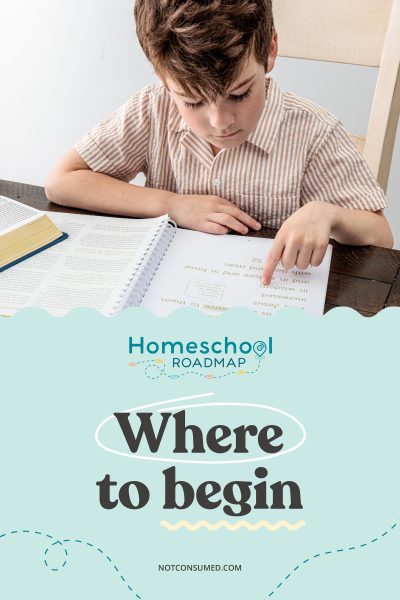
Have you ever found yourself lying awake at night, wondering whether you can really homeschool?
Don’t worry, because you’re not alone! There are many different reasons parents begin to consider homeschooling as an option. Sometimes it’s because their child is struggling in a traditional classroom, while other times it’s because public school no longer fits with their family’s mission or values. Some families are looking for more flexibility, some want deeper relationships and meaningful learning, and others just want an education that allows their children to thrive.
(Don’t forget to grab your free Homeschool Roadmap printable! This comprehensive “map” will help you as you follow along this week, so be sure not to skip it!)
Whatever brought you here, I want you to know that homeschooling has been one of the most amazing things I’ve ever done! I get so excited talking to parents who are considering homeschooling, because I’ve seen over and over again how homeschooling can change everything. Not just a child’s education, but the entire pace of family life. That’s because homeschooling influences everything from relationships within a home, how a family interacts, and most importantly, a family’s faith.
But, for a lot of people, the enthusiasm over the possibility of homeschooling can sit right next to fear.
You may be asking questions like:
- Am I qualified to homeschool?
- What if I mess this up?
- Who says I’m allowed to do this?
- Where do I even start?
If those questions sound familiar, you’re exactly where you need to be.
I’ve been homeschooling for 23 years. I’ve graduated three students, and I have one still in high school. Before homeschooling, I taught for 10 years in the public school system in Florida and earned a master’s degree in curriculum. Because of my background in education, friends often ask me to help evaluate their children during year-end testing or to help them sort through curriculum options.
Over the years, I’ve walked alongside thousands of families who felt willing, ready, and yet completely unsure where to begin homeschooling. Most families who come into homeschooling have a lot of questions. But, the biggest question is WHO?
WHO Can Homeschool?
This is usually the very first hurdle for parents. Even if they don’t say it out loud, the question is always there. Am I actually qualified to do this?
The answer is a resounding yes!
If you are your child’s parent or legal guardian and you are willing to learn, you are qualified to homeschool. Homeschooling does not require a teaching degree or certification, and definitely not perfection! On paper, I looked highly qualified when I started homeschooling. I had a master’s degree in curriculum, years of classroom experience, and had taught in the public school system for a decade. But none of that made homeschooling easier.
Most of my formal training focused on teaching systems. I learned how to manage large groups, juggle learning needs across dozens of students, and keep a classroom running on a rigid schedule.
Homeschooling required something completely different:
- Teaching a child instead of managing a system
- Flexibility rather than rigid pacing
- Slowing down instead of pushing through lessons
That’s when I realized something that changed everything. Formal preparation does not qualify someone to homeschool; a relationship does. Parents already know their children, care deeply about their growth, and are invested in who they are becoming.
Please don’t believe the lie that you’d be better off homeschooling if you had some kind of special training or background. You do not need to know everything on day one. All you need is to be willing to learn and know that you will grow as you go.
I have learned a ton as I homeschooled my kids, and honestly, I wouldn’t have it any other way. My kids have loved seeing me get excited about something just as much as I have loved seeing them learn. When you homeschool, your children will see that learning doesn’t stop with adulthood, and that matters more than most people realize.
If you want to learn more about why I personally chose homeschooling for my family, you can read about it here!
If you still aren’t convinced, here is something encouraging: Research consistently shows that homeschooled students perform well above national averages academically. They also demonstrate strong social and emotional development, and do just as well, or better, than their public school peers when they reach college.
Another important fact to remember when you are considering homeschooling is that you are not alone! Even if you don’t personally know someone who homeschools, nearly seven percent of school-aged children in the United States are now homeschooled. That number has grown rapidly in recent years—almost double what it was just a few years ago. Families are doing this imperfectly, prayerfully, and one step at a time, just like you.
WHO Makes the Rules?
The answer to this question surprises many families. While there are steps that you need to take to make homeschooling legal, the truth is this: You make the rules for your homeschool.
You get to decide:
- What time school starts
- What subjects you teach
- How fast or slow your child moves
- When to pause, repeat, or move ahead
The beauty of homeschooling is that YOU get to decide what’s best for your child, without having to follow the pace of a system that wasn’t built for individuals. That freedom especially matters for families coming out of traditional school environments.
Traditional schools are designed around systems, not individuals. They operate like an assembly line. The pace is set, and everyone is expected to keep up. When a child needs more time, the line keeps moving, and if a child is ready to move faster, the line does not adjust. Teachers are rarely allowed to change the pace, even when they know a child needs something different.
I saw this firsthand when my nephew was in school. The system was failing him. He was facing retention for the second time by second grade. When we withdrew him and began homeschooling, everything changed. Not because he became a different child, but because the pace finally fit him. He caught up, thrived, and graduated on time.
Homeschooling allows that kind of freedom because there’s no “assembly line”, and you don’t have to race against a calendar. You don’t have to move forward just because a page or a planner says you have to.
When your child needs to slow down or go over something again, you slow down and do it again. When they’re ready to move on ahead, you move on ahead. And if your child needs to run around the house ten times before doing another math problem, guess what? You can take a break!
If something isn’t working, you have the freedom to change it. Instead of failure, this is actually good parenting. You have the ability and the flexibility to do what’s best for your child as they learn.
Understanding the Legal Requirements
Now, there are legal steps to begin homeschooling, and those matter. Homeschooling is legal in all 50 states, but each state has its own requirements. These vary, and can include notifying the local school district, intensive recordkeeping, testing, or very little work from you at all.
This is one area where it’s important to go directly to the source. Well-meaning advice often gets shared in unhelpful ways because homeschool laws vary widely from state to state. Secondhand information can add pressure that doesn’t need to exist.
I once knew a parent who believed her state required eight hours of homeschooling every day. She was exhausted and discouraged. Once she read the law for herself, she realized none of that was required. This truth changed her homeschool drastically. The days became lighter, more flexible, and sustainable.
That’s why I always recommend looking up your state’s homeschool law personally. The HSLDA website is a helpful starting point. Read your state’s requirements carefully and look specifically for things like:
- Required number of school days or hours
- Notification or reporting requirements
- Testing or evaluation expectations
- Subject requirements, if any
You may be surprised by how much is not required. Some states require testing, which families can often administer themselves. Other states may require portfolios, which can be as simple as a notebook showing progress. (I have a full video on how to create one here.)
Most states require very little, and even the requirements that they do have may not always be what they seem. For example, if your state requires 180 school days, that doesn’t mean 180 days at a table with books! Learning happens through field trips, projects, and everyday life. Papers and textbooks are not required to learn.
We have a great blog post about how to keep up with your homeschool portfolio, which you can read here!
Once you’ve done what is required, you’re free. Free to build a homeschool that fits your child instead of forcing your child to fit a system. And that freedom is a gift.
What Comes Next
When you understand that you are qualified to homeschool and free to lead it, fear begins to loosen its grip. Instead of worrying about whether this is possible, your attention can turn to what the next right step is. And that’s exactly what this series is designed to help you do. Not to overwhelm you with information, but to guide you forward one decision at a time.
In the next part of the Homeschool Road Map, we’re going to talk about why you want to homeschool and what your vision is for it. Because knowing that you can homeschool is important. But knowing why you’re doing it is what keeps you going when things get hard.
This post is a part of our Homeschool Road Map Series. Check out the rest of the blog posts below!
- Why Homeschool? Start Here Before You Choose Curriculum
- How to Choose a Homeschool Approach without Overwhelm
- New to Homeschooling? 3 Things Your Child Actually Needs to Learn
- How to Create a Homeschool Schedule That Actually Works

Through practical tools & Bible-based resources, Kim Sorgius is dedicated to helping your family GROW in faith so you can be Not Consumed by life’s struggles. Author of popular kid’s devotional Bible studies and practical homeschooling tools, Kim has a master’s degree in education and curriculum design coupled with over 2 decades of experience working with kids and teens. Above all, her most treasured job is mother and homeschool teacher of four amazing kiddos.