
How to Create a Homeschool Schedule That Actually Works

Throughout this series, you’ve (hopefully!) decided to homeschool. You’ve worked through who can homeschool (you!), why you’re doing this, and how you want to approach learning, which includes what you plan to teach. Now you’re left with one very practical question:
When will you actually do school?
(Make sure to pull out your Homeschool Roadmap, because you’re going to want to reference it while you read this post. If you haven’t downloaded your free printable yet, click here!)
This question goes beyond today and stretches across the entire year. What does a normal homeschool day look like? When should school start? How long should it take? Do you start in August or September? Are you going to take summers off, or homeschool year-round?
A homeschool schedule isn’t just about a daily plan. It’s about deciding how learning fits into your life across the entire year.
This is the final piece of the roadmap. It’s the when, which includes both the routine of your days and the flow of your school year.
Why Most Schedules Don’t Work
The biggest mistake new homeschoolers make is trying to do homeschool the way the school system does school.
That’s understandable. Most of us didn’t invent our idea of a “school schedule.” We inherited it and lived it for thirteen years.
For many families, that experience looked something like this:
- Early mornings
- Long days
- A heavy subject load
- Very little margin
So when families start homeschooling, even with the best intentions, they often recreate that system at home. They assume school should start early, last eight or more hours, and cover as many subjects as possible.
Ready for a crazy fact? That eight-plus-hour model was not built around how children learn best. It was built around efficiency in institutions.
Traditional school schedules exist to manage large groups of children all at once. Bells signal transitions. Fixed class periods keep hundreds of students moving on the same timetable. Strict start and end times make transportation, staffing, and supervision work. That kind of structure is about running an institution on time, not about individual learning.
When you bring that structure into a home, it very quickly starts to feel uncomfortable.

Homes don’t function like institutions. Children learn at different speeds. Some concepts take five minutes, and others take five days. Some days flow beautifully, while others don’t.
In a school system, the schedule keeps moving, whether a child is ready or not. At home, you don’t have to keep moving just because the clock says so. This freedom is one of the greatest strengths of homeschooling.

But if you carry an institutional schedule into your homeschool, you end up working against that freedom instead of using it.
This often shows up in a few predictable ways:
- Lessons get rushed to stay on pace.
- You feel behind when something takes longer.
- Success is measured by how closely the day matched the plan instead of by what your child actually learned.
A homeschool schedule doesn’t need to maintain a system. It needs to support learning in a family. That difference changes everything.
A Helpful Perspective on Learning and Time
If you’ve been led to believe that long hours and packed schedules are the gold standard, it helps to look outside our own experience.
Finland’s education system consistently ranks near the top in the world, yet its approach looks almost nothing like what most of us experienced growing up.
Here are a few defining features:
- Formal academics don’t begin until around age seven.
- School starts later in the morning, often around 9:00-9:45 a.m.
- Students typically focus on two or three academic lessons per day.
- Lessons are shorter and intentionally broken up.
- Frequent breaks are built into the day, often outdoors.
- Outdoor time is considered essential, not optional.
- Lunch is long and unhurried.
- Standardized testing is minimal.
- Homework is rare in the early years.
The philosophy is simple. Learning should be developmentally appropriate, balanced, and sustainable. And for homeschool parents, there are three big takeaways:
- More does not equal better.
- Longer hours do not equal more learning.
- Added pressure does not equal stronger outcomes.
Learning thrives when there is margin. Homeschooling can offer that margin if the schedule is not meant to control learning, but instead is built to support it.
What a Homeschool Schedule Actually Needs to Do
In my experience, a workable homeschool schedule does these three things:
1. Centers on the family’s natural schedule
You don’t need to schedule school around an imaginary school day. School should be scheduled around your family!
Here are some questions you should ask yourself:
- When is our household actually awake and functional?
- When are younger children happiest and most regulated?
- When do I realistically have the capacity to teach?
- What responsibilities already exist in our day?
Some families thrive with earlier starts. Others need slower mornings. No matter what that well-meaning person may have told you, there is no moral value attached to starting early!
A homeschool schedule works best when it fits naturally into your existing family rhythms instead of fighting against them. When school fits into life, it’s far more likely to happen consistently.
School fits into the family, not the other way around.
2. Allows for Flexibility
Your schedule needs to be flexible without being loose.
On one extreme is the rigid schedule. Every subject at a set time, planned to the minute. These schedules often look great on paper, but fall apart the first time life interrupts.
Interruptions might look like:
- A doctor’s appointment
- A bad night of sleep
- Lessons taking longer than expected
When these things happen, new homeschoolers often feel like the entire day is ruined.
On the other extreme is no schedule at all. Though this can feel freeing at first, it often leads to inconsistency and the nagging sense that nothing ever really gets finished.
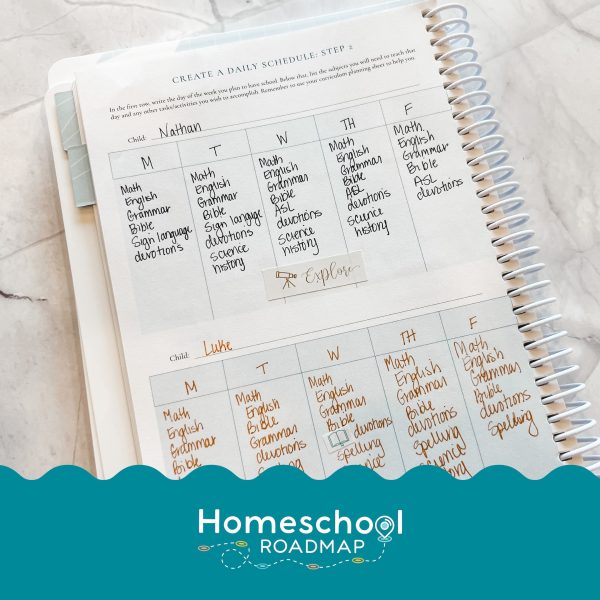
What you want is structure with flexibility.
This is why exact times often cause unnecessary pressure. When a schedule says “math at 9:00” and it’s suddenly 9:20, it already feels like you’re behind. But when the schedule simply says “school time,” you can start when your family is ready, and with which subject they’re ready for.
Flexibility keeps you from giving up on the day just because something didn’t go according to plan.
We actually have a great collection of homeschool planners for every grade level. These planners focus not on keeping a perfect schedule, but instead help your students grow in personal responsibility for their academics, keep God at the center, and make space for real life.
3. Cultivates Independence
A homeschool schedule isn’t only about when school happens. It’s also about what your children are learning regarding responsibility.
When you’re starting out, you, as the parent, will carry most of the structure. That’s appropriate, and very necessary. Over time, however, the schedule should help children learn:
- What comes next
- How to move through routines
- How to complete work independently
- How to take ownership of their day
If a parent has to direct every moment forever, the schedule isn’t doing its job.
This growth happens gradually through predictable routines and clear expectations:
- Morning routines that teach responsibility
- Checklists that teach follow-through
- Time chunks that teach flow and independence
A schedule that trains responsibility doesn’t just get school done. It prepares children for real life.
A Practical Framework That Works
Instead of scheduling by exact times, the day can be organized into chunks. Rather than assigning subjects to specific minutes, the day follows a natural order.
Here’s a simple example:
- a morning chunk
- a school chunk
- a lunch chunk
- an afternoon chunk
- a family time chunk
- an evening or night chunk
These chunks do not have strict start times.
If the morning starts later, the day still works. When interruptions happen, the school day is not lost. And if plans change, chunks simply shift instead of everything falling to pieces.
This one change removes an enormous amount of pressure. Inside each chunk is a simple routine. Over time, children learn the flow, know what comes next, and grow in independence.
The day no longer feels off simply because one thing didn’t happen. That is because the goal isn’t perfection. It’s sustainability.
If you’re a working parent who’s also homeschooling, these chunks can be absolute lifesavers. As a homeschooling, working mom myself, I’ve had to really be intentional in how we plan our days. I wrote a whole blog post about it if you want to see how it works for our family!
Your Homeschool Year
The same mindset applies to your year as a whole.
When should you start your homeschool year? You should start when it makes sense for your family. There is no required start month or school calendar.
Some families start earlier because of the weather. Others start later to enjoy summer. Some adjust around moves, medical needs, or life transitions.
None of those choices is wrong.
Instead of asking, “When should school always start?” you should ask a better question. What works best for your family in this season?
The same is true for breaks. Some families prefer a traditional school-year rhythm. Others do better with shorter, more frequent breaks. Some homeschool year-round with lighter days.
Breaks are not a lack of discipline. In fact, they are often part of sustainability. Most families don’t burn out because they chose the wrong start month. They burn out because they tried to do too much, too rigidly, for too long.
You can always make adjustments, no matter where you are in the school year!
The Most Important Scheduling Truth
A schedule is not meant to control your family. It is meant to serve you.
If your schedule makes you anxious, it isn’t working. If it forces you to ignore what your child needs, it isn’t working. If it collapses every time life happens, it definitely isn’t working.
A good homeschool schedule can hold real life without breaking. That’s what a chunk-based schedule is designed to do.
Bringing the Roadmap Together
At this point, guessing is no longer necessary. The pieces now fit together. You have a roadmap!
WHO: You’re qualified, and you know how to make homeschooling legal without adding unnecessary pressure.
WHY: You’ve anchored your homeschool in purpose.
HOW: You understand methods and how to choose what fits your family.
WHAT: You know what to teach by focusing on what matters most.
WHEN: You can build a daily and yearly rhythm for real life without breaking.
Take this one step at a time. Don’t overthink it. Start with what you know and adjust as you go. You’re not just making a plan. You’re building a home where learning and discipleship can grow steadily over time.
This blog post is the last one of our Homeschool Road Map Series. Check out the previous posts below!
- How to Get Started Homeschooling
- Why Homeschool? Start Here Before You Choose Curriculum
- How to Choose a Homeschool Approach Without Overwhelm
- New to Homeschooling? 3 Things Your Child Actually Needs to Learn

Through practical tools & Bible-based resources, Kim Sorgius is dedicated to helping your family GROW in faith so you can be Not Consumed by life’s struggles. Author of popular kid’s devotional Bible studies and practical homeschooling tools, Kim has a master’s degree in education and curriculum design coupled with over 2 decades of experience working with kids and teens. Above all, her most treasured job is mother and homeschool teacher of four amazing kiddos.







I’m looking for the acronym “FOCUS” that I read in a blog post a while back but cannot seem to find it. In context, the post was about how children can use their quiet time effectively. Can you help please?
Hi Ashley, That acronym is
First things first
Open a book
Create something
Use your talent
Serve
Exercise
Delight
The third video from the boot camp explains a little more about each aspect. You can sign up for that here: https://www.notconsumed.com/homeschool-planning-bootcamp/
-Annie, NCM Team