Why More Isn’t Better in Your Homeschool (5 Mistakes to Stop Making)

More isn’t better when it comes to homeschooling.
It’s worth saying again because so many parents need to hear it: More isn’t better.
More workbooks. More hours at the table. More curriculum. More tests. More pressure. More isn’t better. It’s just…more.
When I tell you more isn’t better, it’s because I’ve watched this play out for decades, on both sides of the desk. For more than 20 years of homeschooling, and 10 years teaching in a public school classroom before that I’ve seen over and over that doing more doesn’t necessarily produce better results.
The families who thrive aren’t the ones doing the most. They’re the ones focusing on the right things.
If you’ve ever worried that you’re not doing enough or felt tempted to keep adding “just one more thing” to your homeschool, this article is for you.
Let’s look at five of the biggest homeschool mistakes families make when they chase “more” in education, and what to do instead. Because a truly excellent education doesn’t come from doing the most. It comes from doing the right things, in the right order, for the right reasons.
Prefer to watch instead of read? Watch the video version here →
Mistake #1: Sacrificing Heaven for Harvard
Of all the homeschool mistakes we’ll cover, this is the one most families don’t even realize they’re making.
We are told, in a thousand different ways, that academics are everything. Get the grades. Use the most rigorous curriculum. Don’t leave gaps. So families buy the thickest textbooks, schedule ten hours of school a day, and feel guilty when they don’t get through every page. They keep adding more, because more feels like safety.
But here’s the question I had to ask myself, and I want to ask you. What is actually at the top of your priority list?
I’ve met many families at homeschool conventions who poured everything into academic achievement, only to find their children didn’t have the spiritual foundation they hoped for. The schedule was full of school, but there was no room left for what matters most. Academics took up the whole year.
That’s the real cost of more. And more of any subject is never worth it if it costs your child spiritually. I believe that with everything in me.
So what do you do instead? Ask yourself: Harvard or Heaven? What do I actually want for my child at 25, at 40, at the end of their life? Your child’s spiritual growth is not the subject you squeeze in after everything else is done. It’s the foundation everything else is built on.

Thick textbooks don’t mean better. Demanding doesn’t mean excellence. If a curriculum is so exhausting that it crowds out time with God’s Word, it isn’t serving your family. It is consuming it. Look for curriculum that keeps Scripture at the center, woven into how your child learns to see the world. When education starts there, your schedule has room to breathe.
Mistake #2: Believing the Busier Day Is the Better Education
Somewhere along the way, homeschoolers started looking at traditional school as the standard to match. The school runs seven hours a day, so we should too.
But traditional schools are built to manage groups of twenty-five or thirty kids. Assemblies, lunchrooms, transitions, fire drills. All of it takes up the clock, and none of it is learning. Schools fill the hours because they have to.
And friend, you don’t have to.
Homeschooling’s greatest advantage is that you can do in two or three focused hours what a traditional school takes all day to do, because your child is moving at their own pace. When you build your day to match what school looks like, you give up that advantage. School starts consuming the day. Pressure replaces joy.
Real life is not a distraction from education. It IS education.
So what do you do instead? Ask yourself: does this curriculum fit our real life, or does it require a perfect life? Can I realistically do this on a hard week, not just a good one? Because a plan that only works on good weeks is not actually your plan. It’s just an idea.
Mistake #3: Believing More Pages Means More Learning
Of all five homeschool mistakes, this is probably the one that does the most damage.
The thinking goes: if I assign more pages, they’ll retain more. So parents pile it on. Worksheets, review packets, extra practice, reading logs. More proof that learning is happening.
Then reality hits. Kids hit a wall fast. And when they hit that wall, they don’t learn more. They stop learning entirely. They shut down and start dreading school.
I’ve seen families proudly running a 7-8 hour school day with kids who are miserable and barely retaining anything. And I’ve seen families doing two and a half focused hours with kids who are curious, engaged, and excited to keep going. More work didn’t produce more learning. It produced more resistance.
Especially with young children, short and focused is not lazy. It is developmentally correct. A forty-five minute, hands-on lesson will produce more genuine understanding than two hours of worksheets, every single time. As kids grow, the standard shouldn’t be heavier. It should be more meaningful. That’s what real rigor looks like, not the thickness of the book.
So what do you do instead? Stop asking “how much can we fit into today” and start asking “what does this child actually need right now?” That question will take you somewhere worth going.
Mistake #4: When Something Isn’t Working, Adding More
You know how this one plays out. Reading isn’t clicking, so you buy another reading program. History feels thin, so you add a timeline curriculum. Science needs rigor, so you add a lab book. Before long, you’ve got eight or nine programs all moving in separate directions. Nothing is connected. Everyone is exhausted. And you still feel behind.
But the problem was never that you needed more programs. The problem is that none of them are talking to each other.
Real life doesn’t sort itself into a math moment and a history moment. Everything connects. But most curriculum treats every subject as its own separate box, and then we wonder why nothing sticks. Kids are left asking, “Why do I have to learn this?” And we don’t have a good answer for them.
The solution isn’t more. It’s integration. History connected to geography, to the people, to the time period. Science pointing to the order and design built into creation. Reading and writing as tools your child uses across everything they study, including God’s Word. When learning is connected, kids can see how it fits.
Mistake #5: Believing More Involvement Equals More Learning
This last one comes from a really good place. Caring parents end up managing everything. Every assignment, every checklist, every step. They hover. They remind. They rescue.
In the early years, that close involvement is exactly right. Young children need it. But we keep doing it, all the way through middle school and high school, and then wonder why our kids can’t do anything without being told.
The answer is that we never stepped back. We built dependence when we meant to build confidence.
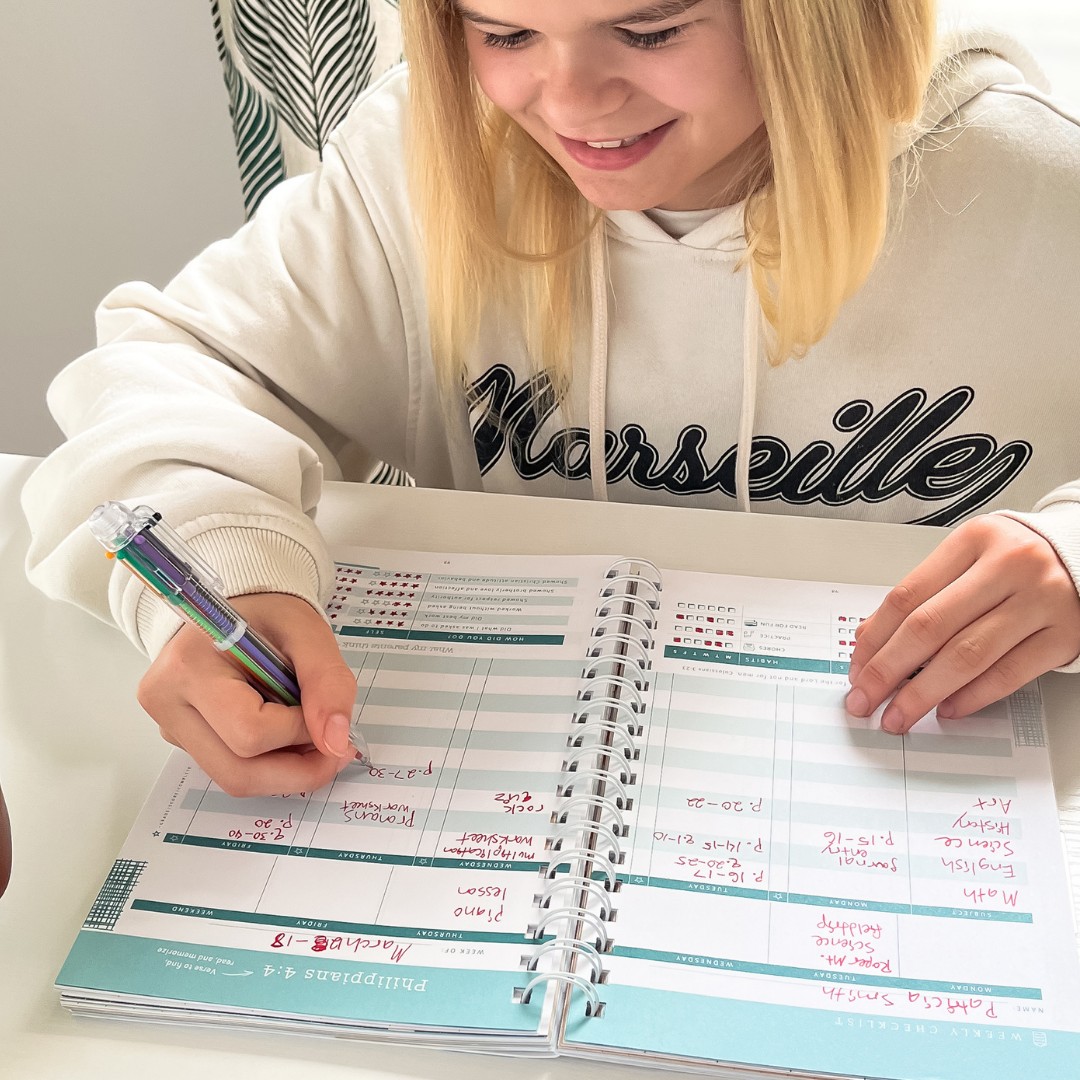
So what do you do instead? Build independence deliberately and gradually. Teach them to use a checklist, then let them use it without reminding them. Give them ownership over their assignments, and let them feel what happens if they don’t follow through. Don’t rescue them before they even try.
And this starts in kindergarten. Don’t wait until middle school. The habits they build in the early years carry into how they manage their time, keep commitments, and eventually own their faith. The goal isn’t just to graduate a student who completed a lot of assignments. It’s to raise a person who can handle what God puts in front of them.
You can’t get there by doing more for them. You get there by equipping them to do it themselves.

Stop Going After More
I hope this encourages you to stop chasing more. Your homeschool doesn’t need more. It needs what matters.
More hours won’t give your child a better education. More programs won’t fix what isn’t connecting. More pages won’t build a love of learning. More management won’t raise a responsible adult. And more academic pressure will never be worth it if it costs your child the thing that matters most.
More isn’t better. It’s just more.
What your child needs is a foundation that puts first things first. A plan that fits your real life. Learning that is meaningful. Subjects that connect. And an intentional path toward independence. That’s what we’re working toward at Not Consumed, because we believe your homeschool should strengthen your family, not consume it. Take a peek at our homeschool curriculum collection to see it in practice.
If this encouraged you today, would you share it with another homeschool parent who might need to hear it?
And leave me a comment below. I want to know: what’s the one thing you’re going to take off your plate? Because sometimes the most important homeschool decision you’ll make this year is not what to add. It’s what to finally put down.

Through practical tools & Bible-based resources, Kim Sorgius is dedicated to helping your family GROW in faith so you can be Not Consumed by life’s struggles. Author of popular kid’s devotional Bible studies and practical homeschooling tools, Kim has a master’s degree in education and curriculum design coupled with over 2 decades of experience working with kids and teens. Above all, her most treasured job is mother and homeschool teacher of four amazing kiddos.