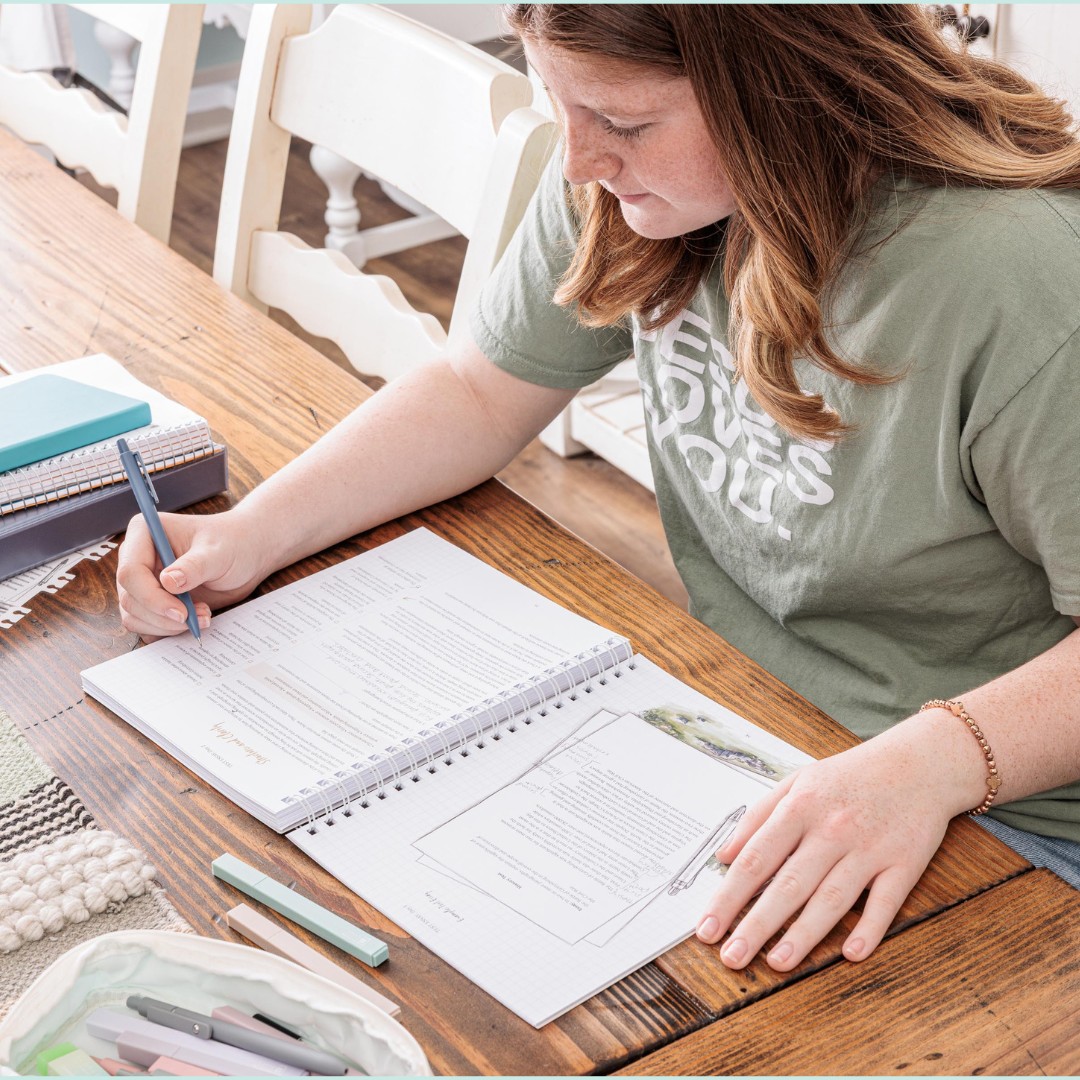
The Homeschool Schedule That Finally Worked for Our Family

It’s 7:45 on a Tuesday morning. I’m walking down the stairs and the house is quiet. Not the scary quiet where someone is definitely drawing on a wall with a Sharpie. The good quiet.
I walk into the kitchen and all four of my kids are engaged. Planners open. Cereal bowls rinsed and in the dishwasher. Dressed, hair brushed. One is curled up on the couch reading. One is finishing a chore. Nobody is fighting. Nobody has asked me a single question. I didn’t say “Go get dressed” even once.
I stood there thinking, what a beautiful miracle.
It wasn’t a miracle. It took a lot of hard work, so let me rewind to one year before that morning.
Picture me. It’s 10 AM and I’m still in my pajamas. There is cereal on the floor. Not in a bowl. On the floor. Someone is crying upstairs because they can’t find their shoe. One shoe. I’m standing at the bottom of the stairs yelling, “Why are you not dressed? We were supposed to start school an hour ago!” I’ve already lost my patience and we haven’t opened a book. It is only Tuesday.
That was my normal for a long time. I’ve been homeschooling for 23 years, I’ve graduated three kids with one high schooler left at home, and twelve of those years I was a single mom. I’ve been the yelling mom, the crying-in-the-bathroom mom, the desperate work-from-home mom. After all that trial and error, I finally landed on a homeschool morning routine that stuck. It came down to two things that need to happen before school even starts.
Rather watch than read?
The Mistake I Kept Making
For a long time I kept trying to recreate a classroom schedule at home. Thirty-minute blocks, strict start times, every subject slotted into its little box. It failed. Every. Single. Time.
Diaper blowouts don’t follow a schedule. Some concepts take longer to learn than expected. And those wonderful rabbit trails of curiosity often lead to the most meaningful learning moments.
So I threw out the traditional school schedule for something I call chunk scheduling. You divide your day into flexible chunks: morning, school, lunch, afternoon, evening. Each chunk has a routine inside it, not a strict start time. If something unexpected happens, like a doctor’s appointment or, yes, a diaper blowout, you move the chunks around. You’re never “behind” because you’re not tied to a clock.
I’ve written more about building a homeschool schedule that actually works if you want the full system. But the chunks only hold together when a homeschool morning routine is running underneath them. Ours has two anchors: the morning routine checklist and the morning meeting.
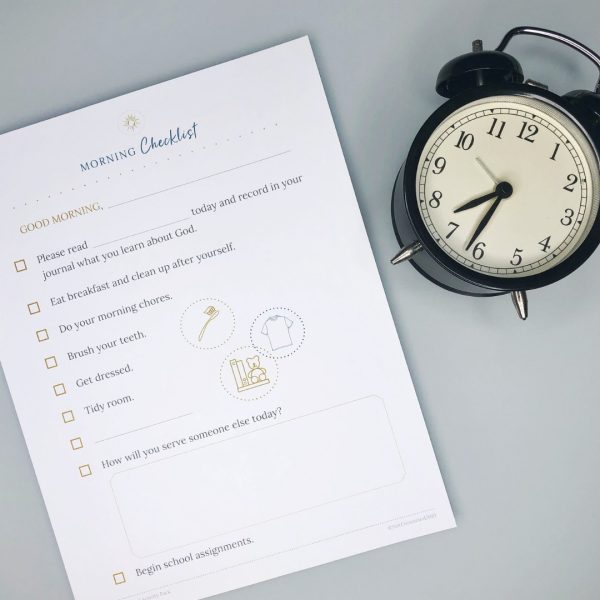
Our Homeschool Morning Routine Checklist
If this part falls apart, nothing else in the day goes smoothly.
I used to think raising independent kids meant throwing them into the deep end and hoping they’d figure it out. That led to me constantly nagging and them feeling overwhelmed and incapable. Independence is a gradual, intentional process. Kids need structure before they can operate on their own. And kids who wake up without a plan? They’ll either veg on the couch or start writing on the walls with Sharpies. So we built a morning routine checklist with five steps.
1. Time with God
The best time to spend with God is first thing in the morning. It focuses their thoughts on truth and lets God direct their day. When kids are little, I read to them from one of our Bible studies and they follow along. As they get older, they work through their study on their own. Reading God’s Word helps us know Him, and it helps us know how to live.
2. Breakfast
This used to be the bane of my existence. Then I discovered breakfast stations. Once a month we prep and freeze muffins, breakfast burritos, energy balls, and smoothie packs, sorted in clear containers at their height so even the youngest can grab what they need. They’re also responsible for cleaning up after themselves: rinsing their plate, loading the dishwasher, wiping their area. Breakfast feeds them, but the cleanup teaches them they’re contributing members of our household.
3. Self-care
Brushing teeth, washing face, brushing hair, getting fully dressed. Younger kids go right down the checklist. Older kids use the personal care section in their planner as the reminder. There’s nothing better than realizing at 9:00 AM that everyone is dressed and ready without a single reminder from you.
4. Tidy your room and chores
Making the bed, picking up pajamas, keeping dirty clothes off the floor. These were non-negotiable. Did they do them perfectly every time? No. But it set the tone for caring for our blessings and kept the house from looking ransacked every single day. If you need help deciding what your kids can handle, here’s our age appropriate chore list from toddlers to teens.
5. Reading time
This is the final step before we come together as a family. It’s open-ended, which gives slower kids a chance to finish everything else and gives mom a chance to be ready. Each of my kids has a book box full of materials at their reading level. For pre-readers, this is picture reading, which is a real skill on the way to reading words. Don’t skip it.
What makes the whole system work is the checklist itself. We keep ours in our homeschool planners, starting in Pre-K so kids develop these habits early. As they grow, they move to the habits section in their elementary, middle school, or high school planner. The physical act of checking things off on paper creates accountability and builds executive functioning skills they’ll need for life. Plus, it just feels good. You’ve written something down that you already did just to check it off. Our kids feel the same way.
One more thing. Set the planners out the night before so the morning can actually flow. Mornings have a way of surprising you, like when your kid suddenly needs an ironed shirt and your iron has been a doorstop for six months.
The Morning Meeting
Once everyone is fed, dressed, and ready, we come together for what I call our morning meeting. This is where the school chunk begins, and it became the part of our day I cherished most. When the kids were little, it gave the day a format. As they got older, it became a time to connect before the world scattered us in twelve different directions. It has four parts.
We start with one question: “What is God teaching you?”
Every child brings the Bible study they’re working through in their quiet time. I ask what God is teaching them, and we talk about it. Each child is learning on their own level, but everyone has the same key truth and key passage, which makes discussion natural even across ages. This is how I hold them accountable for time in God’s Word, but it’s an invitation. If no one has anything to share, I share what God is teaching me and we move on.
Some of the most meaningful conversations I’ve had with my kids happened during this time. Sometimes it was deep. Sometimes someone asked a completely unrelated question about pickles. We’re not going for perfection. We’re going for presence.

Our Bible studies are designed so every age level works through the same key truth at the same time, and the parent guide gives you the same study at an adult level plus discussion questions.
Next, we pray together
We use simple prayer cards to guide us through praise, confession, thanksgiving, and requests for others. Some days this is quick. Some days someone has something heavy on their heart and we stay longer. Hearing my kids pray for each other and for people they’ve never met is something you can’t manufacture. You just create the space for it.
Then we study something briefly together
A missionary study, a hymn study, or apologetics. Our all-time favorite was Faithipedia, a flipbook full of the things you really want your kids to know: theology words, the Bible timeline, the names of God. We work through it as a family and each kid responds in their own Faithipedia journal. It takes five to ten minutes, and it adds up over time.
Finally, announcements
Today we’re going to the orthodontist. You have piano at 3:00. This is what’s for dinner and who’s helping. Kids write it down in their planner. It takes two minutes and eliminates the “I didn’t know we were doing that” conversation later.
And then we begin school.
What Holds It All Together
The morning routine checklist and the morning meeting are your anchors. A few more things kept the whole system sustainable over two decades.
- Become best friends with your alarm: I set alarms for everything, wake-up, work time, waking the kids, the morning meeting. The more alarms I used, the more on target we stayed. Without them, time disappeared into the same vortex as the missing socks.
- Leave more time than you need: if we had somewhere to be, I calculated how long we needed and added an extra half hour. Being rushed led to frustration, anger, and words we regretted.
- Stay flexible: if the morning gets thrown off, you haven’t lost the day. The school chunk starts later, or the afternoon chunk swaps with the morning.
- Teach your kids to work independently: this is what made the morning meeting possible. When kids know what to do next, you’re not playing “What do I do now?” all day long. Start with developing independent learners.
Start With One Piece
A homeschool morning routine that works comes from the right structure, not the perfect wake-up time. The morning routine checklist gets your kids up, moving, and responsible before school starts. The morning meeting brings your family together around God’s Word and sets the tone for everything else. And the chunk system holds it together with enough flexibility to survive real life.
The tool that makes all of this possible is the homeschool planner. It holds the morning checklist, the school checklist, the habits tracker, everything your kids need to take ownership of their day. We have planners for every age, Pre-K through high school.
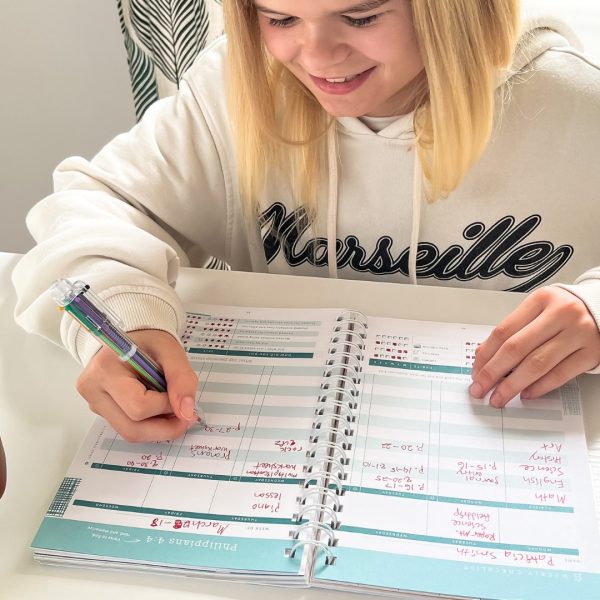
Pick one piece of this and try it for a week. Just one. Maybe it’s the morning checklist or a morning meeting. Maybe it’s setting out the planners the night before. Start small, master it, then add another piece. Before you know it, you’ll have a homeschool morning routine that actually works for your family.
Which piece are you going to start with? Tell me in the comments. I’d love to hear.

Through practical tools & Bible-based resources, Kim Sorgius is dedicated to helping your family GROW in faith so you can be Not Consumed by life’s struggles. Author of popular kid’s devotional Bible studies and practical homeschooling tools, Kim has a master’s degree in education and curriculum design coupled with over 2 decades of experience working with kids and teens. Above all, her most treasured job is mother and homeschool teacher of four amazing kiddos.