How to Choose a Homeschool Approach Without Overwhelm
If you’re just getting started with homeschooling, you may already know why you want to do this. You know that you want something different for your family, and you’ve thought through what you want it to look like in a hypothetical sense. But when it comes to the practical, day-to-day details, things can start to feel overwhelming pretty quickly.
As you begin researching, you will find that there isn’t just one way to homeschool. You may have already run into terms like Classical, Charlotte Mason, unit studies, textbook-based, and eclectic. The more you read, the more it can feel like you’re collecting pieces without really knowing what the best choice is for your family.
In this post, we’ll walk through the most common homeschool approaches, what they typically look like in real life, who they tend to work well for, and how you can start narrowing things down for your own homeschool.
If you’re new to this series, this is the third post in our Homeschool Roadmap.You may want to read Why You Homeschool and Where to Begin Homeschooling first. Also, don’t forget to grab your FREE PRINTABLE HOMESCHOOL ROADMAP. It’ll help you keep track of all that we’re talking about this week.
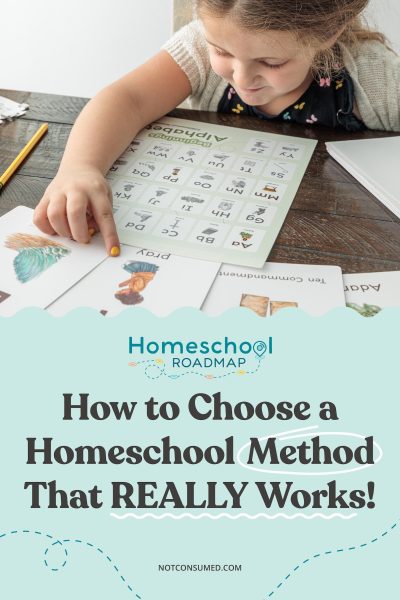
Your Homeschool Method Comes After Your WHY
Before getting into specific homeschool approaches, there’s one important thing to keep in mind. Your homeschool method doesn’t come first; your WHY does.
(Look back on your “why” that you wrote down yesterday!)
The approach you choose is simply how you carry out the vision you already have for your homeschool. When the WHY is clear, decisions about curriculum and structure tend to feel much less overwhelming.
At its core, a homeschool approach is just a framework. It helps organize learning, guide how you teach, and shape the overflow of your days. It isn’t a measure of success, and it doesn’t lock you into a long-term commitment.
Most families don’t stick with the same approach forever. As kids grow and life changes, what works well one year may need to be adjusted the next. That kind of flexibility is completely normal and is actually one of the great things about homeschooling.
Think of your WHY as the blueprint. Your approach is simply how you build from it. That’s why these approaches work best as tools, rather than labels. They’re meant to support your family, not define it.
Classical Homeschooling
Classical homeschooling is a structured approach that builds knowledge in stages. It often includes memory work, discussion, logic, and rhetoric that grow as your children do.
This approach often works well for families who enjoy routine and predictability, including:
- Kids who do well with patterns and memorization
- Parents who want a clear academic progression
- Students who enjoy academic challenges
It can feel less helpful if:
- Flexibility is important to your family
- Your child strongly dislikes memorization
- Structure begins to feel like pressure instead of support
Classical homeschooling tends to be a good fit when structure brings clarity and steadiness to your homeschool.
Traditional Textbook-Based Homeschooling
Traditional, or textbook-based, homeschooling looks a lot like school at home. Lessons are usually laid out in a clear sequence using textbooks and workbooks. If you’re new to homeschooling, it probably looks the most familiar to you.
For families transitioning out of public or private school, this familiarity can feel reassuring. Knowing what comes next often helps both parents and students feel more confident during a season of change.
Textbook-based programs often work well for:
- Children who prefer clear expectations
- Families who want a defined scope and sequence
- Parents who feel more comfortable starting with a familiar format
Programs like Abeka, BJU Press, and Horizons fall into this category.
However, this approach can feel frustrating if:
- Your child learns best through movement
- Flexibility is a priority
- School-related stress starts creeping back in
Traditional/textbook-based learning isn’t good or bad on its own. This is simply one tool, and it tends to work best when supporting other learning types instead of taking over the entire homeschool.
Charlotte Mason
The Charlotte Mason approach focuses on short lessons, living books, nature study, and habit formation. Instead of long hours of seatwork, the emphasis is on attention, curiosity, and meaningful learning.
This approach often works well for:
- Younger children
- Families who enjoy reading together
- Those who want learning to feel gentle and engaging
Common examples of this method are programs like Simply Charlotte Mason and Beautiful Feet Books.
This method can feel challenging for parents who:
- Want very specific benchmarks
- Prefer detailed daily lesson plans for every subject
- Need a high level of structure across the board
For our family, this approach made a big difference with two of my kids. One of my sons struggled to sit still early on, and traditional bookwork was a constant challenge. When we shifted to shorter lessons, more movement, and time outside, learning finally clicked for him.
If you still need convincing that learning outside is a viable option, read this post, which is a defense for nature-based learning!
Unit Studies
Unit studies organize learning around one central topic and weave multiple subjects together, such as reading, writing, science, and history.
They often work well for:
- Families teaching multiple ages
- Kids who enjoy diving deep into a topic
- Parents who enjoy hands-on learning
Unit studies can be especially meaningful when they connect to real life, like preparing for a family trip or following a child’s natural curiosity.
Unit studies may feel overwhelming if:
- Prep time is limited
- You need a consistent daily structure
- Life feels unpredictable
Eclectic Homeschooling
Many families eventually realize they don’t fit neatly into just one homeschool method. Looking back over more than 22 years of homeschooling, we were eclectic far more often than anything else.
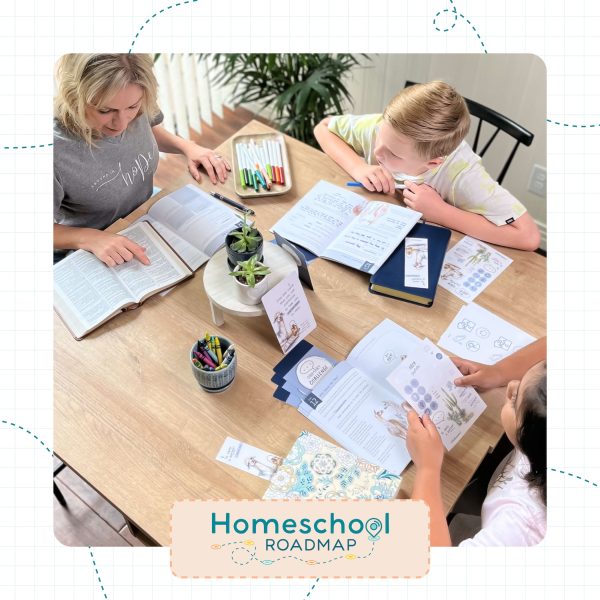
Eclectic homeschooling simply means using the pieces that work best for your family and letting go of the rest. This flexibility allows you to adjust as your kids grow and your needs change.
I’m a big fan of this blended approach, so much so that it’s reflected in how our homeschool curriculum is designed. Our pre-K curriculum, All Around Town, and kindergarten curriculum, Backyard & Beyond, combine hands-on learning, nature exploration, unit study, and just enough structure to support learning without overwhelm.
We also have 1st and 2nd grade curriculum that has been created with that same approach. Creatures in Creation and Discoveries in Motion use real-life field trips, hands-on learning, and meaningful connections to bring learning to life in a vibrant, effective way.
Your Homeschool Space
Once you start thinking about your homeschool method, another practical question usually follows. Where is all of this learning actually going to happen?
Your homeschool space should support how your family learns and lives. Early on, we set up a very traditional schoolroom with desks, wall charts, and classroom routines. While it looked great, it didn’t actually fit our kids very well.
Over time, learning naturally moved into our shared living space. Open shelving, accessible supplies, and flexible seating made it easier to supervise, stay organized, and move between school and daily life.
As our family changed, our homeschool space changed too. The goal was never perfection. It was always about choosing what worked best for our season. Over the years, I put together a great list of homeschool supply must-haves. These were things that we actually needed and used, not the useless stuff I panic-ordered online in the middle of the night. You can check it out here!
Your homeschool space doesn’t need to look a certain way. It simply needs to support your method and your WHY.
What Comes Next
Now that you’ve explored different homeschool approaches and started thinking about what may fit your family, the next step is deciding what to teach and how to choose curriculum without overbuying or second-guessing yourself.
In the next post, we’ll walk through that process step by step.
This blog post is a part of our Homeschool Road Map Series. Check out the other posts below!
- How to Get Started Homeschooling
- Why Homeschool? Start Here Before You Choose Curriculum
- New to Homeschooling? 3 Things Your Child Actually Needs to Learn
- How to Create a Homeschool Schedule that Actually Works!

Through practical tools & Bible-based resources, Kim Sorgius is dedicated to helping your family GROW in faith so you can be Not Consumed by life’s struggles. Author of popular kid’s devotional Bible studies and practical homeschooling tools, Kim has a master’s degree in education and curriculum design coupled with over 2 decades of experience working with kids and teens. Above all, her most treasured job is mother and homeschool teacher of four amazing kiddos.