
Why Good Kids Still Make Bad Choices: Teaching Kids the Fruit of the Spirit

We walked into Publix one afternoon, and the angelic halos were shining bright around my family.
The kids were gentle. Nobody broke anything. And people noticed. Smiles in the checkout line. “Oh my goodness, they are so well behaved.” I walked out that door feeling like Supermom.
Then we got to the car.
One kid stepped on another kid’s foot, and the halos got tossed aside for flying fists and hateful words. Maybe four seconds from the sliding doors to the car door.
Nothing changed between the store and the parking lot. Same kids. Same hearts. The only thing that changed was who was watching.
Once I saw it, I saw it everywhere. My kids were good for their teachers, the neighbors, and the sweet ladies at church. Then we would shut the door at home and it all came off. I had not raised kids who loved God. I had raised kids who were really good at looking like it. And I had taught them how. For years. On purpose.
If we haven’t met, I’m Kim Sorgius Jones, founder of Not Consumed Ministries. I raised four kids as a single mom, three of them now grown and graduated, and I have made every mistake in this post.
If that parking lot sounds familiar, don’t feel guilty. There is something better: kids whose relationship with Christ holds when we’re not in the room, instead of kids who perform Christianity and walk away at nineteen. So why do good kids still make bad choices? The answer has almost nothing to do with our kids, and almost everything to do with how we’ve been teaching kids the fruit of the Spirit.
Rather watch than read?
What the Fruit of the Spirit Actually Is
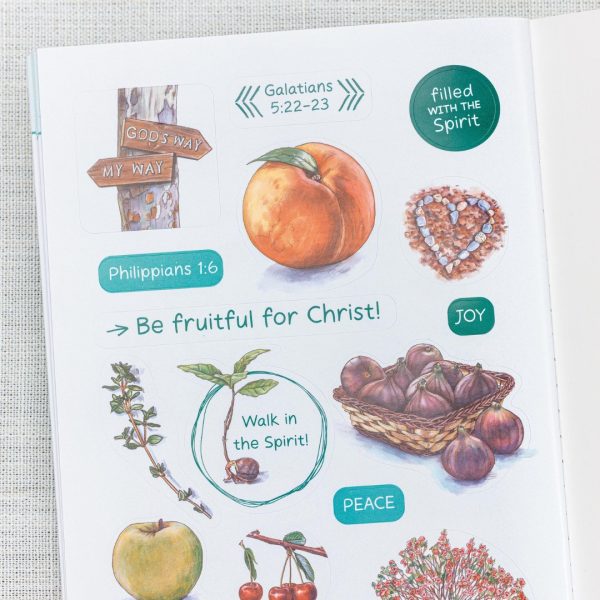
You know the song. The fruit of the Spirit is not a watermelon. Not a coconut. Not a cherry. Nine words, easy to memorize, and most of us walked away with the same idea: nine things a good Christian should have.
But there is something in Galatians 5 that I missed for years. In verse 19, Paul lists the works of the flesh. Plural. A pile of separate things we do. In verse 22 he says the fruit of the Spirit. Singular. One fruit, nine sides, one source. It is not the fruit of trying harder. It is not the fruit of a really consistent mom. His name is on it.
That list describes what it looks like when God is at work in someone’s life. Somewhere along the way, we took something God said He would do and handed it to our kids as homework. That is how teaching kids the fruit of the Spirit turns into an assignment they can only fail.
Behavior Is the Fruit. The Heart Is the Root.
Jesus already gave us the diagram. Matthew 12:33 says the tree is known by its fruit. Luke 6:45 says “out of the abundance of the heart his mouth speaks.” So when our kid yells at his sister, the yelling is the report. Bad fruit is information about the root.
Trying to fix behavior without touching the heart is like duct-taping apples onto a dead tree. From the road it looks like an orchard. Get close, and nothing is growing.
Keep correcting your kids. Obedience matters, and discipline is loving. But correcting behavior will never change a heart. Most of us know that. We just don’t know what else to do. (I dig deeper into this in Behavior Problems Are Belief Problems.)
Why We All Start With the Behavior
We do it for two honest reasons. Behavior is the only part we can see. Hearts are invisible. Fruit is right there on the kitchen counter at seven in the morning.
And it works. A sticker or a consequence gets compliance out of most kids, and it feels like progress. It just doesn’t last, and by the time we find that out they’re fifteen. We didn’t do this because we were lazy. We love these kids, and a behavior chart was the only tool anybody ever handed us.
Most kids end up on one of two roads.
Road one is the kid who can do it. Compliant, capable, praised. What he is really learning is that Christianity is a performance, and he happens to be good at it. That was my kids in the Publix parking lot. They weren’t being good. They were being watched.
Road two is the kid who can’t. The strong-willed one who blows it before nine in the morning. She is not learning to be patient. She is learning that something is wrong with her and God is disappointed.
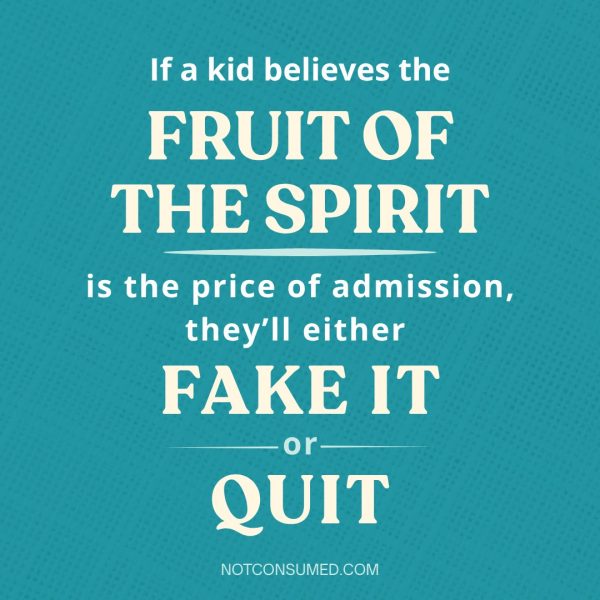
Our kids have to know that God loves them while they are still sinners, and that salvation is a free gift, never a wage for good behavior. If a kid believes the fruit of the Spirit is the price of admission, they will either fake it or quit. (That is a big part of Why Good Kids Lose Their Faith.)
Both of those kids are standing under the same duct-taped tree. One is proud of it. The other thinks she is the reason it is dying. And both of them behave when we are in the room. One day we will not be in the room.
3 Ways to Start Teaching Kids the Fruit of the Spirit
We cannot change a heart. But we can put down the tape. Teaching kids the fruit of the Spirit starts in the ordinary hard moments you are already living.
1. Change the question
Stop asking “Why did you do that?” They don’t know, and it invites a lie. Ask what was going on in their heart instead. What did you want in that moment? What were you believing about God right then?
Still give the consequence. Just don’t stop there. Let the behavior be the doorway into the conversation instead of the whole conversation.
2. Give them the tools to know Him
Our kids can’t love someone they don’t know. They can’t want to please a God who is just a rulebook to them.
So the strategy, the whole strategy, is getting our kids into God’s Word for themselves. Not when they’re twenty. Right now. Their own Bible, their own hands, their own questions. (5 Heart Issues Our Kids Deal With digs into what that looks like.)
3. Let them watch you need God
Out loud. “I lost it this morning. That came out of my heart and it was wrong. I already asked God to forgive me, and I am asking you to forgive me, too.” A kid who has never watched a grown adult repent does not know how to do it.
Then pray for the root. In Ezekiel 36:26, God promises to remove the heart of stone and give a heart of flesh. He is responsible for the heart change in our kids. Friend, that ought to be a huge relief. Our job is to faithfully show up and keep talking about Him, just like Deuteronomy 6 says.
Roots are slow, and we can’t see them. A behavior chart gives us results by Friday. A root gives us results over many years. Even Jesus told His disciples, “Apart from me you can do nothing.” If they couldn’t produce fruit on their own, we can lower the bar for our seven-year-old.
Psalm 1 says the tree planted by streams of water yields its fruit in its season. Not on our calendar. If you are not seeing much fruit right now, that might just be a season, not a verdict on you. Keep watering.

Fruit That Grows When Nobody Is Watching
Behavior is fruit. The heart is the root. Our job is the garden, and God’s job is the roots. The fruit does come. It grows out of our kids’ relationship with Christ, not out of the chart.
I went looking for a resource for teaching kids the fruit of the Spirit without turning it into nine more things they were failing at. Everything I found was a character study: here is a good trait, go practice it. So we wrote the study I wanted. Spiritual Fruit is twenty days, about 10 to 15 minutes a day, with three age levels plus a Parent Guide so the whole family is in the same study at the same time. Kids don’t even get to love and joy until Day 5, because first they learn why they can’t produce any of it on their own. There is not one behavior chart in it. Every day points them back to the Holy Spirit, because that is whose fruit it is.
I duct-taped fruit onto my kids for years, and I still catch myself reaching for the tape.
Leave a comment and tell me which fruit you have been trying hardest to force out of your kids. Mine was patience. For about a decade. And I was the one who didn’t have it.

Through practical tools & Bible-based resources, Kim Sorgius is dedicated to helping your family GROW in faith so you can be Not Consumed by life’s struggles. Author of popular kid’s devotional Bible studies and practical homeschooling tools, Kim has a master’s degree in education and curriculum design coupled with over 2 decades of experience working with kids and teens. Above all, her most treasured job is mother and homeschool teacher of four amazing kiddos.