
21 Consequences for Kids That Really Work

Ideas from the experts and the trenches, these creative consequences for kids will mean you’re never disappointed with the age-old “time-out” again.
After 13+ years of parenting, teaching 100’s of public school children, and reading more books than I can count, I feel confident in one thing. This parenting thing is HARD, ya’ll. There isn’t a one-size-fits-all answer for our parenting questions. I really thought there was. I believed the formula was the answer.
If you do these steps, your kid will turn out like “this.” You’ve probably heard some of these too…
If you, put them on a schedule…they will sleep through the night at 3 months.
If you are consistent in your training…they will obey the first time you ask.
If you conduct a potty boot camp…they will potty train in less than 3 days.
I have come to realize just how laughable this really is. There is absolutely nothing wrong with any of the above ideas. In fact, most of them have worked for me at least with some of my kids, some of the time. The trouble lies in our demanding that they work in all situations. And if we do that, we are ignoring the fact that children are humans. Natural born, flesh-filled, sinners (Romans 6:23). Even the best of us are prone to give in to momentary pleasures, throwing caution to the wind. Bottom line, there isn’t one consequence for kids that works every time.
So are we hopeless in the quest for getting our kids to do what we ask? Must we throw in the towel on respect and obedience?
Absolutely NOT!
But we might need to change up a few traditional practices if we want to see a change in our kids. We are going to need to get CREATIVE! Hopefully, you’ve figured out by now that kids are different. All of them. Between my four children and the numerous other children I have taught, I have seen everything from perfectionist to uninterested, compliant to defiant, thoughtful to manipulative, and calm to active. The list goes on and on and I certainly haven’t seen it all.
I need unique consequences for each of my kids and each situation will need some creativity. So let’s look at some creative ways to get to the heart of the matter and spur them towards that respect and obedience we so greatly desire as parents.
Table of Contents
Start with obedience
Before we can even get to the business of giving consequences for kids for wrong behavior, we need to set the stage for obedience. Our kids need to know exactly what is expected of them and why. They also need to understand the importance of obedience, consequences of disobedience, and how/why we have authority over them to begin with. With little ones, this knowledge can wait, but if your child is over the age of 5, it’s time to make sure he/she understand these things before giving out consequences.
If this isn’t something you’ve done with your kids, click on the image below for tips and ideas to get the conversation started.

Create simple rules
Rules should be few and simple. You can’t create a constitution full of detailed circumstances because your kids will indeed come up with a new behavior not covered. Instead, make 1-3 simple rules that encompass the atmosphere you want to create for your family.
They can’t be too difficult to remember or too vague that they include loopholes. For a long time, my rule was simply LOVE. Quite some time ago, my friend Lara introduced me to her version of this concept…Love Up and Love Out. First, we love God and serve Him. Second, we love others through our love for God. I’ve used that saying ever since. After all, love covers a multitude of sins and this rule really does covers every offense in my home.
I might ask: How are you showing love in this situation? Is there something that you could do to be more loving? When you didn’t pick up that shoe on the stairs, do you think you showed love and concern for the well-being of your family who might trip over it?
The Bible says that the greatest commandment is love. Teaching our kids to put this at the foundation of their choices reinforces this truth and it helps kids to understand the importance of obedience.

Get creative with your consequences for kids
As much as possible, I avoid terms like “time-out” and “restriction.” For the most part, I have found that a blanket consequence for kids is ineffective in molding hearts and changing behavior. This is where natural and logical consequences come in.
A natural consequence will be administered without mom’s help. For example, a child runs on the sidewalk, trips, and skins his knee. Natural consequence. Ouch.
A logical consequence for kids is closely related to the offense and is aimed at teaching responsibility for your actions. This consequence is administered by a calm and collected adult wishing to help children make wise choices. They aren’t one size fits all and don’t even need to be the same every single time. The idea is to find something that hurts enough to change the behavior, leaving a related memory for next time the child considers doing the same thing. For example, if you take away a party with friends because a child leaves his bike in the snow, it’s not directly related and may not be effective. If you take away the bike- now we’re talking.
Whenever possible, I include scripture with consequences, but don’t beat yourself up about this and don’t preach a sermon either. I find that the best faith-based discussions are done when kids are not in the thick of trouble. In the moment they are focused on the consequence, guilt, and pain. If you lecture, kids might get defensive and it will be wasted. Save it for a time when there is no conflict.
Before you give consequences to kids
It’s vital that we evaluate the situation objectively before giving our kids consequences. The more level-headed we can be, the more impact it will have on their hearts. I ask my self 4 questions before giving a consequence. In the video above, I detail these questions. Here is a short summary.
—> Is this a sin against God’s law or an inconvenience for me?
—> Is this foolishness or childishness?
—> Do I desire to look good right now?
—> Have I given my kids the grace I expect to be given to me?
If we honestly evaluate those questions and still feel the child needs a consequence, it’s pretty safe to say that it’s not being given in irrational anger. Again, watch the video above for a detailed look at what each question means.
Creative consequences for kids
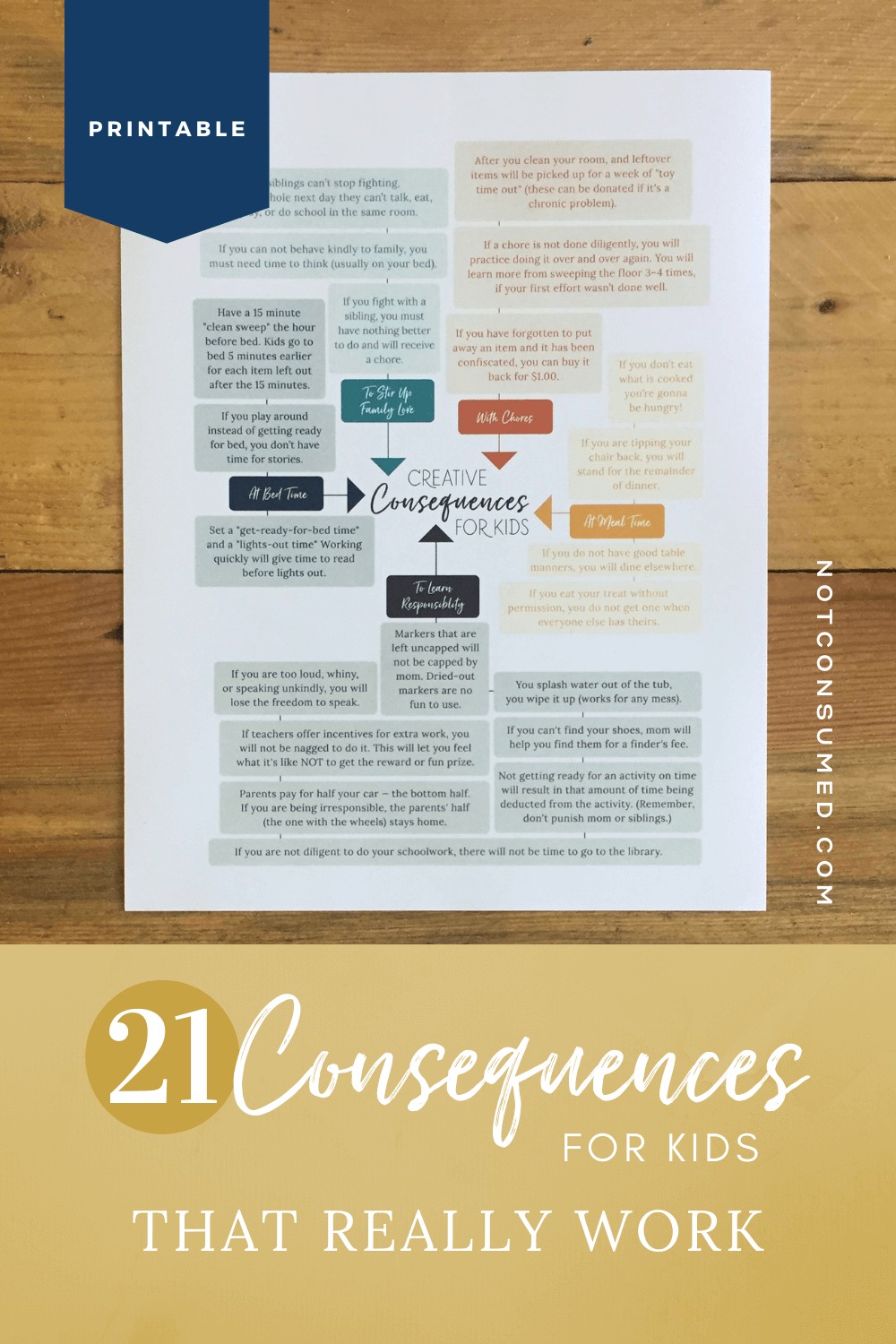
If you can’t find your shoes, mom will help you find them, but there will be a finder’s fee.
If you can not behave kindly toward your family, mom will assume that you need some time to think about it and send you to another room to sit (usually the bed).
If you fight with your sibling, I will assume you have nothing better to do and give you a chore.
After you are sent into a room to clean up, I come behind and take the items that were left out. I assume that you no longer want these items and place them in “toy time out” for a week. (Mom could also donate the items, if this is a chronic problem.)
If you are tipping your chair back, I will assume that it is unsafe for you to use it and you will stand for the remainder of dinner.
If you do not have good table manners, you will be asked to dine elsewhere.
If you are too loud, whiny, or speaking unkindly, you will lose the freedom to speak. (Works really well in the car, too.)
If you can’t get ready for an activity on time, I will deduct that amount of time from the activity once we get there. (Remember not to punish mom or the siblings because of one child’s negligence.)
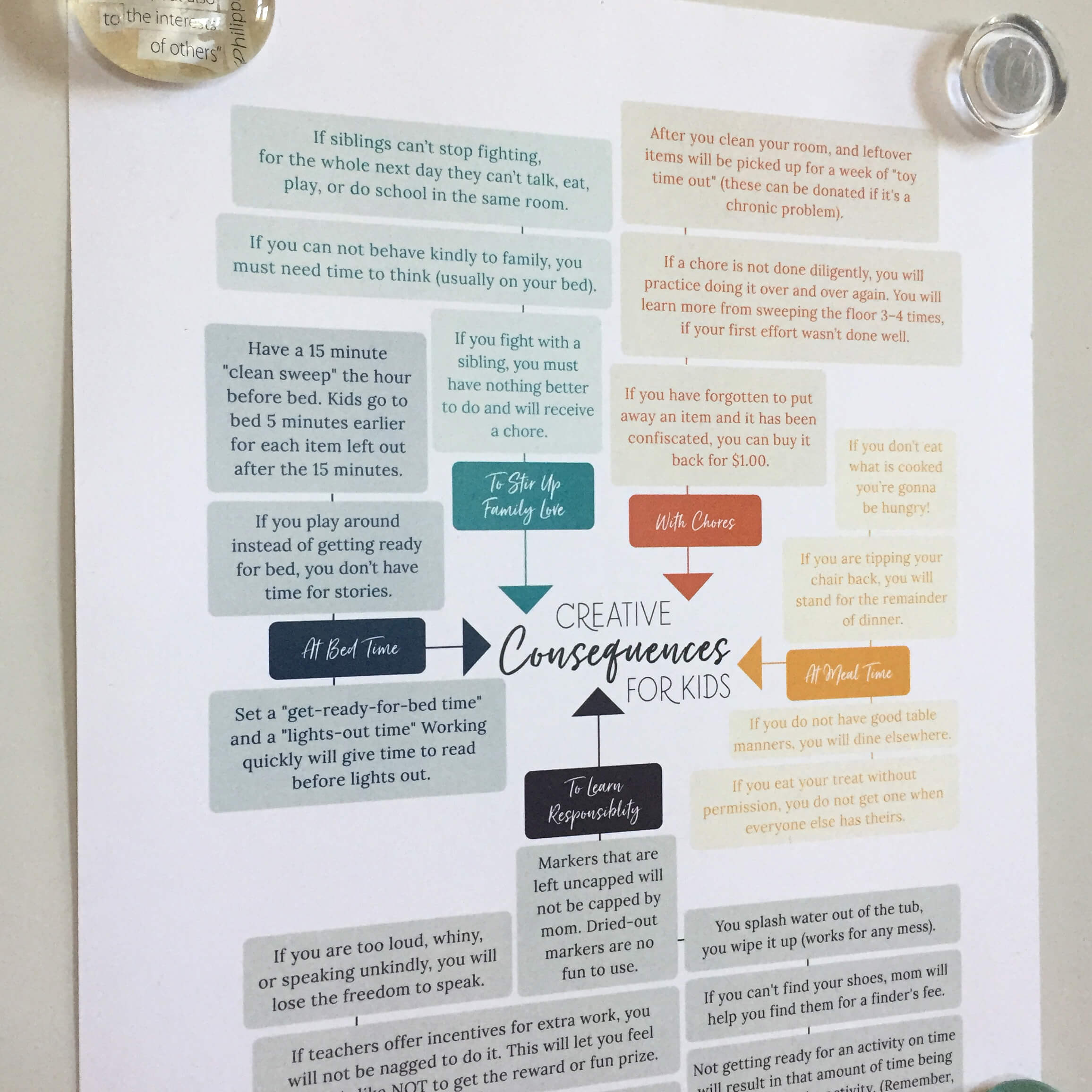
A few creative consequences for kids from my friends...
If they play around instead of getting ready for bed, we don’t have time for stories. ~Christy
The kids weren’t diligent to do their schoolwork today so there wasn’t time to go to the library. ~Debby
Somebody ate his treat without permission so he did not get his treat later when everyone else was eating theirs. ~Julie
If teachers offer incentives for extra work or even situations like AWANA, I don’t nag them…I let them feel what it’s like not to get the reward or fun prize. ~Tiana
You splash water out of the tub, you wipe it up (works for any mess). ~Leslie
If you don’t eat what mama cooks you’re gonna be hungry! ~Amy
The rule is: We pay for half your car. We own the bottom half. If you’re being irresponsible, our half (the one with the wheels) stays home, in the driveway. ~Pam
We’ve set a “start-getting-for-bed time” and a “lights-out-time.” If they get ready fast, they can use the remainder to read. If they play around getting ready for bed, they can’t… the lights out time doesn’t change. ~Josh

I also don’t cap markers that were left uncapped. Dried out markers are no fun. ~Leslie
A few ideas from Creative Correction by Lisa Whelchel…
About an hour before bed, have a whole house “clean sweep.” Set the timer for 15 minutes. For each item left out after the timer goes off, the kids go to bed 5 minutes earlier.
If you have forgotten to put away an item and it has been confiscated, you can buy it back for $1.00.
If a chore is not done diligently, have your child practice doing it over and over again. She will learn more from sweeping the floor 3-4 times because her first effort wasn’t done well.
If siblings can’t stop fighting, have them go the whole next day without the pleasure of each other’s company. They can’t talk, eat, play, or do school in the same room.
Creative consequences for kids printable
We’ve created a free printable to make it easier to think of consequences when you need them. Hang this free printable on your fridge or inside a cabinet as a quick reminder when you need it or as inspiration for other ideas.
To get your FREE creative consequences printable, enter your information below.

Further help with consequences for kids
God is always just. There will be a consequence. Even if it never becomes obvious to us. Teaching your children that lesson now reaps great benefits both spiritually and physically. If you heard anything at all in this post, I hope you heard that parenting is not a one-size-fits-all activity. Some of these ideas might not work. Some great ideas were not even listed here. And most importantly, no one is speaking badly about any parenting ideas. Here in the trenches, we need all the help we can get.
Mom, you rock. You are loved and treasured even with peanut butter in your hair. Keep doing this thing.
Need help thinking of a consequence for kids when you are mad? Read How to think of a Better Consequence When You are Mad
Need toddler ideas? Read Parenting the Toddler Years.
Get more obedience tips here —→ How to help kids obey
If you’d like to lead your child through a Bible study on obedience, I wrote Obey to help us as parents teach our kids the how and the why behind obedience. I pray it blesses you in your parenting journey!

More posts about obedience
- Pointing a Rebellious Child to God
- Is Kid’s Time Out Effective
- 5 Tips for Your Disobedient Child
- Teaching Your Child the Importance of Obedience
- How to Get Your Kids to Stay in Bed
- How to Teach Your Kids to Stop Interrupting
- When Your Child Embarrasses You in Public
- 3 Christian Discipline Questions to Ask Your Kids
- How to Limit Screentime and Get Your Kids to Obey
- How to Get Your Kids to Listen

Through practical tools & Bible-based resources, Kim Sorgius is dedicated to helping your family GROW in faith so you can be Not Consumed by life’s struggles. Author of popular kid’s devotional Bible studies and practical homeschooling tools, Kim has a master’s degree in education and curriculum design coupled with over 2 decades of experience working with kids and teens. Above all, her most treasured job is mother and homeschool teacher of four amazing kiddos.



If my teen has a potty mouth then they have to clean every potty in the house ( we have 5 potties!).
I have been struggling with what to do about our 12 year old daughter’s potty mouth. We have tried the “fine” thing, (it cost her 50cents each time, but that has not been effective at all. I love, love, love your idea! Thanks so much for sharing, I will be trying it for sure, sadly, probably today.
If we are at home, I would remove them from the room. Simply pick them up and put them in another room. If we are in public, I would have them cover their mouth with their hand (or hold it there for them).
Once, my 2 year old and 3 year old were screaming/screeching at each other in the car. I pulled over into an empty parking lot and removed them from their car seats. I sat them on the concrete and said- when you can be quiet, you can get back in. I got in the car and sat down. Honestly, I had no idea what would happened, but I just knew that I couldn’t take anymore! A few minutes passed and they got in the car and NEVER again did I have to do more than warn them to stop screaming at each other.
I’ve also used this in the grocery store. I took the screaming kid out of the cart and put her on the floor. I told her that she could get back in when she could stop screaming. I turned my back (but not my mother “eyes”) and pretended to shop. She got back in the cart and didn’t not scream again.
If your child is a runner, I’m not sure I would try this. 🙂 But hopefully that gives you some ideas!
We call it a “mouth hug” in our family.
As a teacher, I found this highly affective with all ages: if you can’t get along while playing a game or use it properly, the game goes away. There is no need for the adult to jump into the drama of who had the Lego first. The first time someone has conflict or catapults a Lincoln Log, give the warning. The 2nd time, have the kids clean up the game and put it away.
As a reminder to all Mommies: be consistent. Follow through on what you say you will do.
These work well with older kids too. When you start to have power plays with almost-adult kids, it really helps to take the emotion out. “I’m sorry you didn’t arrange for a ride home from work and missed the bus. There’s no one available right now. You can walk (it’s only 7 miles) or you can wait til someone can come to get you – there will be a $5 fee.”
When my kids were younger and would squabble, I made them run laps. “If you have energy to fight, you have energy to burn.” They’d run outside during nice weather, or stairs inside during bad weather. I found this really did take the fight out of them. They’d start with 2 laps, and it would double every time I had to speak to them again. ;o)
One thing you left out, both parents have to be on the same page. The children have to know that Mommy and Daddy talk to one another and that they back each other in what is being done.
Just wondering what your finders fee is for helping with the lost shoe/sock/toy/etc/etc? I feel like I’m the keeper of all things in my home and I would love to get more out of it than, “Oh, thanks for finding that for me.” (when they weren’t really looking because they knew I would find it or I would know where it is. A finder’s fee is ingenious and I wonder why I never came up with it!
It depends on the age of the kid. Also the amount of money they get/have. The idea is to hurt their pocketbook enough to make them think twice.
My kids don’t get an allowance and generally have little money. My fee for most things is $1. Often, my kids don’t have that much to give so they are assigned an extra chore to earn the money.
how are children sinners are birth? that is pretty mean if you ask me
http://www.grace-bible.org/Files/Leader_Resources/How_Do_We_Know_That_We_Are_Born_Sinners.pdf
Exactly. In here we learn consequences for our OWN actions. Why would we be held accountable for Adam’s? Sure, we are all mortal because of Adam, but I don’t think anyone can really sin until they know the difference between right and wrong, which comes much much later than birth.
I do not believe that Children are sinners at birth. In fact scripture tells us that satan has no power over minds of children and it is not in their nature to sin. As mankind and because of the fall of Adam, we only have the ability to sin once we reach an age of accountability to The Lord. Which is the reason it makes sense to teach consequences and not punishments. We are not held responsible for the sins of our first parents (Adam and Eve) any more than our living parents.
I’ve read my Bible many times and I do not know what reference you are pulling when you say that the Scriptures say that Satan has no power over minds of children and that it is not in their nature to sin. Where does it say that? I do however see in the Scriptures that “No one is good, no not one…” Romans 3:10. This doesn’t mean our children are horrible, it just means they need a Savior and a parent who will guide them to know, love and serve the Savior.
Has anyone here heard of the Love and Logic stuff? It’s Charles Fay and his dad. Amazing stuff and similar to what you’ve been talking about.
We have the opportunity to teach our kids and give them lessons for a good “price”. Teaching your child to take care of their bike properly with natural consequences is a lot easier than suffering the consequences of them not taking care of a car later in life. It’s not all about money either. Teaching our daughters their true value as young girls is a lot easier and pays off when they’re 16 and know how they are supposed to be treated by guys.
I LOVE this post. Recently I found myself being stumped on what tools to use when staving off a power struggle or disciplining my kids. I know that it’s best to have an arsenal…but I could never remember everything when I was in the middle of it. So I started writing down all the tactics I had acquired from y reading…this list has been great in adding to what I have. Now their consequences will never get old, I’ll always have enough options to consider depending on the situation and it’ll keep the kids on their toes and hopefully stay encouraged to continue demonstrating positive behavior.
What a great article and great suggestions for natural consequences. We try really hard to use natural consequences, but sometimes it is hard to figure out what the best natural consequence is in certain situations, and then, how to enforce those natural consequences.
I have a question about being the being whiny, or speaking too loudly and you loose the freedom to speak – how exactly do you stop a child from speaking, especially in the car when you’re driving? This is something we have a very hard time with with my daughter, 4 1/2, who is extremely strong willed. She often yells loudly in the car, especially when her brother is trying to talk to her, and if we tell her that she has to be quiet and isn’t allowed to talk or yell anymore, she will just yell louder. Maybe she’s too young for this to work with her? But I’m just wondering what happens when you can’t really enforce the natural consequence? I’m mean we can tell her she’s lost the freedom to speak, but we can’t actually enforce it – you can make a child stop talking or yelling. I don’t like the idea of pulling the car over to punish the child, so what else can you do?
And I meant – you can’t make a child stop talking or yelling.
Looking forward to your thoughts! Thanks!
One thing I learned from the “love and logic” series is to make “enforceable statements.” Meaning, only say things that you have control over. You are right–you canNOT “make” a child stop yelling. So tell her something that you DO have control over. …We will turn the radio back on when there is no yelling. This car will start moving again when it is quiet in here. Etc. I hope this helps!
Have her put her hand over her mouth. Expect it to work. Also, practice it at home. The more consistent you are at home, the more likely they will be to obey in the car. (I know, easier said than done! Don’t beat your self up- just keep trying!)
2 of my 3 children would just tell me “no” and refuse if I told them to put their hand over their mouth and a real power struggle would result if I tried to hold it there for them. However, something like we will turn the radio will be turned back on when the yelling stops would work for them. Great discussion, like you said different things work for different kids and it is so great to be able to ask each others advice here. 🙂
I just found this thanks to Pinterest and I have to say YOU ROCK! I have been scouring the internet for consequences that would be easy for my 4 and 6 year olds to understand and that would work. To be honest, we have tried the spanking, time outs for xx amount of time and constant raising of our voices to no avail…this mama is worn out. Putting this into affect tonight!
This is such a wonderful post! My son is 3 1/2 and we have been teaching him about rewards and consequences. All of the mom’s are so right…kids today don’t know what it is like to have consequences for their actions. I’m beginning to learn my little guy is too smart for his own good. 🙂 Timeouts never work, counting to 3 never works…we have tried it all! My biggest frustration I have is that when I try to explain to him why he is in timeout and that his actions are unacceptable he laughs in my face. Any suggestions b.c at that point it is hard for me to continue to parent in love and not frustration.
Don’t explain much. Make sure that your consequence is quick and consistent. For example, if he hits, say- hands are not for hitting. That’s it. He is far too little for a 10 minute lecture filled with your emotional issues. haha. I say that because I know how frustrating it is when I child doesn’t obey. But remember, it’s not about you. If you spent more than a few seconds explaining why he has a consequence, you are really just making yourself feel better.
I would also say that your son is still a toddler. Most of these consequences and rewards are not applicable. Did you see the follow-up post that I wrote for toddlers? Perhaps that would help.
when my mom would catch my sister and I yelling at each other she would always say, well if you like yelling so much I am going to set a timer and during that time you both have to yell at each other and cant stop until the timer goes off. And since you like yelling so much, you can only yell and not use any words. You would be surprised how long six minutes seems when you are forced to spend the entire time yelling sounds at your sister. Even worse, my mom would invite her friends over to watch. Oh the humiliation. Let’s say we stopped yelling.
Love this. If kids feel that they are grown up enough to make their own decisions they need to acknowledge that they must also face the consequences of their actions.
For siblings with “different sides” to the story, I tell them to go away and come back when they both have the same story. I let them hash it out so I don’t have to be the cop. Shockingly the story they end up with I don’t think is what actually happened but tends to make both of them seem a little more innocent and the heart of the matter is typically resolved by the time they tell me!
I love this idea!! So clever. My parents pulled the big t-shirt out and put us both in it together. Not fun at first, but you tend to make up quickly, even if just to get out of it!!
I love this post. Through my 8+ years of parenting, I’ve learned that you can’t make a kid eat, sleep, or poop. You can create the best environments & situations for such activities, but you can’t make it happen.
We’ve confiscated toys for a time (or permanently in some cases) and we’ve made kids stand at the table; bathtime is over if there is splashing; a time apart is often helpful to all members of the family. I’m anxious to try some of these other solutions.
My daughter used to slam her bedroom door when she got mad…the door came off for 24 hours. After the third time of having her door removed, she has stopped slamming the door. 😉
My mom always says my brother and I fought the most right before meals, so her solution was to tell us, “Proverbs 17:1 says, ‘Better a dry crust with peace and quiet than a house full of feasting, with strife.’ so if you two don’t stop fighting, you will both be getting a dry piece of toast and water for your meal.” Worked every time.
If my kids did something they had to be punished for I would make them tell me who punished them. Since they were punished for something THEY did they had to tell me “I punished me”. I started this when I realized my daughter wasn’t sorry for what she’d done, only for getting punished. I had to make her see that I wasn’t punishing her, she was.
Any creative ideas for teaching a 5 year old when it is ok and not okay to talk? He is getting in trouble in kindergarten already for talking too much. Taking favorite things away is not working. I’m willing to try anything!
As a former classroom teacher, there is only so much you can do as mom. If you aren’t there in the moment, it can be hard to help him learn when to talk and when to be quiet. In my classroom, I would have the student put his hand over his mouth. I also used a lot of nonverbal cues like putting my hand over my mouth and making eye contact. 5 year olds are just learning this skill when it comes to being in public. (And no, this isn’t a license for parents to step back and let the teacher do it all, but in this case, the teacher might be the biggest help!) 🙂
If the teacher is in regular contact or has a daily behavior management plan ( like smiley faces or something like that), use that as your gauge and respond accordingly.
If the kids get mad and slam the door or shut it unnecessarily hard they have to stand there and open and shut the dooniche right way 30-100 times. I choose the number based in the serveritty of the action. We have a problem of leaving the lights on when they leave a room. If they leave the light in a room on they have to do the same. Turn the light on and off the number of times I choose always ending with the light off.
If the kids get mad and slam the door or shut it unnecessarily hard they have to stand there and open and shut the dooniche right way 30-100 times. I choose the number based in the serveritty of the action. We have a problem of leaving the lights on when they leave a room. If they leave the light in a room on they have to do the same. Turn the light on and off the number of times I choose always ending with the light off.
Hi Kim, just found your blog via pinterest. And wow!!!! I was wondering if you would do a post on disciplining with scripture. I would love to have a list of scriptures that I could teach my little one with every offense so that I can teach him what God says about it. You mentioned doing a post on it but I don’t see anything. Please?!! 🙂
Liesl
I really need to get on that, huh. 🙂 I put it on my schedule!
First, I enjoyed the blog and really like a lot of these ideas.
I would just remind everyone that, like the author said, not all things work for all kids…particularly ones with disorders. I am a teacher now but I have ADHD, and I remember being an sensitive, eager to please, ADHD child. It’s a lot about looking at the child’s capabilities and handicaps and their heart. Punish them for sin, teach them that there are consequences, direct them in social behavior, and help them where they cannot help themselves (for example; you wouldn’t give a child with Tourette’s a “consequence” every time he shouted, or flailed). Also, please remember that there’s grace. As adults we do not receive the “natural consequences” of a lot of our actions, life offers so much grace in light of our mistakes, and I think as Christians we often teach “You must pay for everything in this world one way and another. There is nothing free except the Grace of God.” Which is not true; grace, that glorious blessing that inspires us to live with vigor and repent with tears, is present in our lives every day, from not crashing when we read that text message to not scarring our children when we react with anger, so be willing to give grace to your children, too. 🙂
I just wanted to say how much I truly appreciate your comment Lori. I have two sons with Autism and unfortunately they have a very hard time understanding consequences the way other children do. As much as I love the tactics mentioned in this post and by other readers I also realize that my parenting journey is not the same as theirs. Grace and love are the only things that get through to my children in moments where the overstimulation from the environment is more than their minds can handle.
So glad I read this post. My 4 yr old is quite a handful and it feels as if my husband is alway parenting with “fear “- not just with love and understanding – well written and was well received by my husband — thanks – love reading your posts – keep then coming!
“The rule is: We pay for half your car. We own the bottom half. If you’re being irresponsible, our half (the one with the wheels) stays home, in the driveway. ~Pam”
I love it!!
Me, too, I thought that was great! 🙂
Some of these are just terrible. Making your kid stand at the table? A fee for finding shoes? What a parent you are. Your kids will be rebels when they’re older, because of you.
Wow Kailin! Do you honestly think these suggestions are too harsh?! Are you a parent yourself yet or a child? There is not one single tip on here that would put a child in harm in anyway. These are simply consequences that everyone will face in life one way or the other for wrong behavior. However you have the choice by teaching your children these yourself out of love and concern for them or let
world teach it to them out of hate a ridicule. I love my children enough to try my darnedest to do it myself, its your choice to do the latter. Out of curioustey, if you think teaching you children right from wrong with these loving unharmful and healthy suggestions
Continued from last post…my computer is acting crazy, I apologize. But I was trying to ask Kailin if she thinks these suggestions are cruel, then I would love to know her parenting tips or are her kids the ones that everyone hates to see coming because they have never been taught manners or right from wrong! You do your child more harm by not having.g consequences and discipline. Their lives will be very difficult. Not to mention the people around them that have to put up with their behavior! Will be checking back often Kailin, I am very anxious to hear your parenting advice!
Better to be made to stand at the table than to tip over backward and end up in E. R. getting stitches in the back of the head (Happened to my husband in high school, when he should have known better). My students know that if I have to tell them more than once not to lean back, they’ve lost their chairs for five minutes.
Is the child being lazy, or does he really not know where his shoes are? If it’s worth it for me to find his shoes, it’s worth a finder’s fee.
The school where I work sets expectations and consequences for not meeting those expectations. We’ve all read Teaching with Love and Logic, which works very well. Choices have consequences. One can make good choices, or poor ones, but one must deal with his own choices. Or, as I’ve told students a few times: “I can’t make you behave yourself, but I can make you wish you had.”
This post is full of a lot of great ideas. Until you’ve raised kids – or hung around them all day like I do – you really don’t know what is necessary to be a parent or teacher.
these are all really great ideas but they are not natural consequences. as in, it’s not what happens without your intervention. i think that these are logical enough though that children should understand their application in the real world. sans finders fee.
But as an adult, if I break or lose something I own, I have to go buy another. I call it a stupid tax, but you could call it a finders fee. If I make a mess in my own house, I have to go get a rag and clean it up. Not only that, I then have to clean the rag I used! If I don’t pay my car payments, the bank takes the car away. If I don’t take care of my car, it breaks down. If I treat people badly or say unkind things to them they will not want to be around me anymore. How are these not natural consequences experienced by adults? By making them more obvious and pointing them out to our kids, we are ‘intervening’ but only to make the consequence known for what it is. Kids don’t have the judgement to understand cause and effect. It’s our job as parents to point it out so they can learn to understand this trend on their own. So when they’re adults, they’ll think ahead to the consequence of their decisions. Procrastinate on your oil changes and pay for a new car. Make a mess when you’re cooking dinner and it takes twice as long to clean.